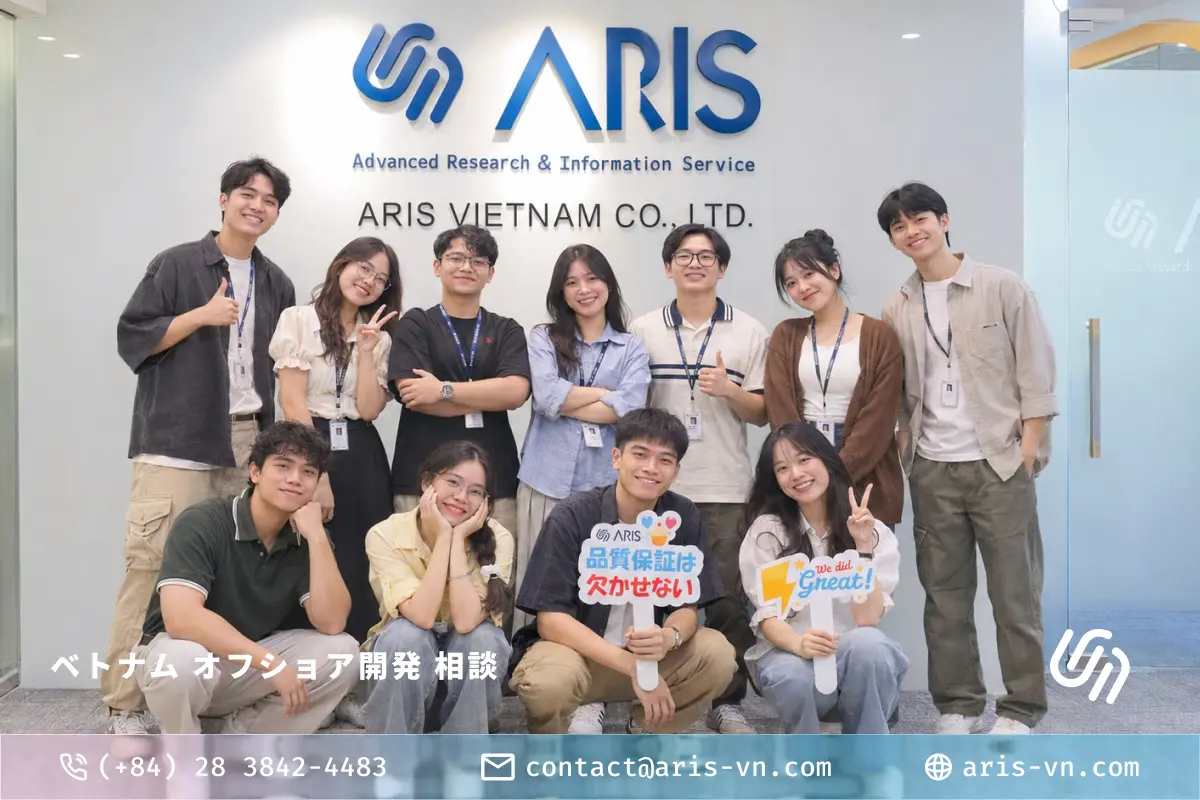
Every year, ARIS Vietnam brings in a new class of freshers. Not because we are short of people.
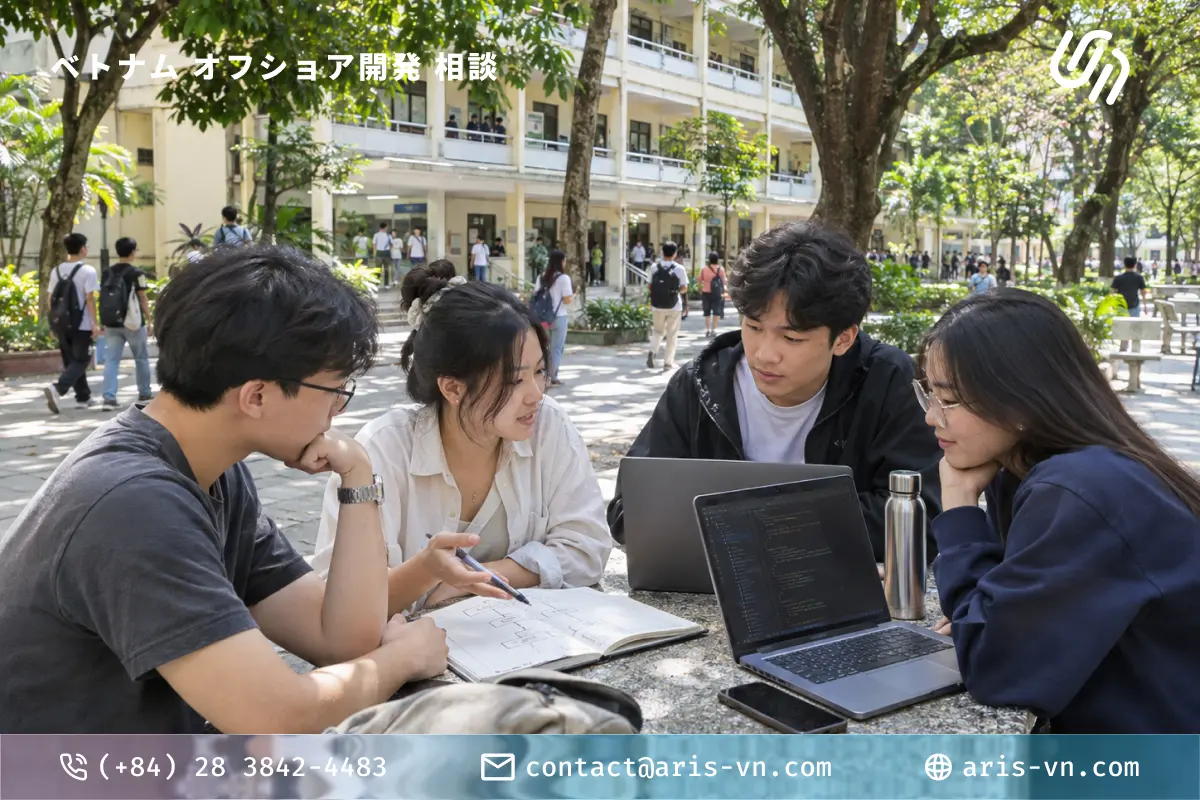
Every year, we work with universities to select and train a new generation of engineers. They do not come in for a few talks and then leave. We give them workspace and meeting rooms, and we put them on real projects — working alongside the engineers and BrSEs who run projects for clients in Japan, the United States and France. They get exposed to each country's working culture, real processes, real deadlines and real bugs.
Many people ask: why invest so much in freshers?
The answer is not about recruitment. It is about a promise we keep to our partners.
Training the next generation is not a cost — it is insurance for our partners
When a company chooses ARIS as its software development partner, it is not just hiring a team to finish one project. It needs to know that whenever it calls, we will be there — at every generation of engineer, at every level of project. That is a non-negotiable requirement.
So training the next generation is not a cost. It is the insurance we buy for our partners — so that whenever they need us, we have the right people ready. The model works for all three sides: students get real project experience, a company like ours keeps a sustainable talent pipeline, and partners get the assurance that the team will never "run out of people."
That is the promise ARIS Vietnam makes to its partners, and to itself. For 15 years we have grown steadily on that principle.
But AI is changing the training equation
Right now, one thing worries us: AI is breaking how the next generation learns the craft.
One senior on our team — eight years of experience — now delivers with AI the volume of work that used to take three people. In an internal meeting, someone asked the blunt question: "So do we still need to hire freshers?"
In the short term, it sounds reasonable. A senior with AI really is doing the work of two or three people.
But we answer that question with another question: three years from now, who replaces that senior when they leave?
The career ladder is losing its middle rungs
If we do not hire and train freshers today, then in three to five years there are no juniors, no mid-level engineers, and no one rising to senior. The engineer pipeline breaks from the inside.
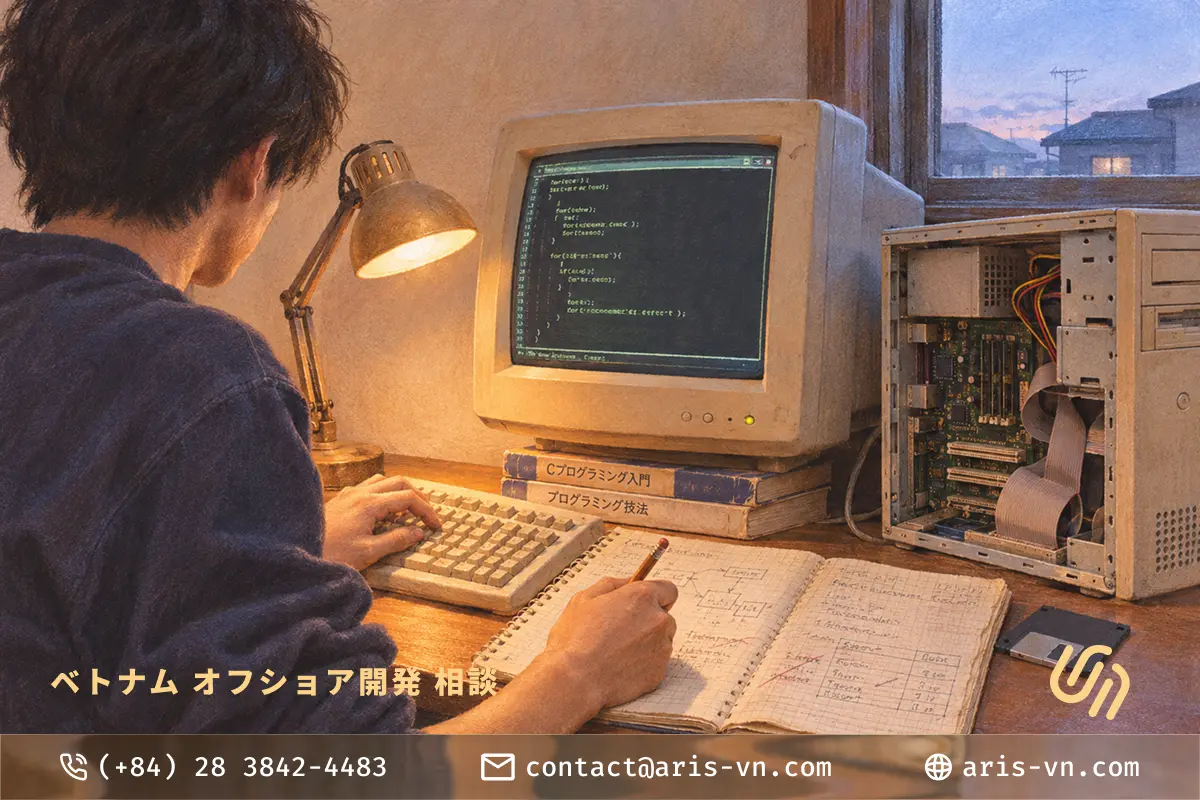
The old way of learning the craft was a closed loop: a fresher got a small task, wrote the code themselves, got it wrong, had it reviewed, understood why it was wrong, built up experience, and moved from junior to senior.
With AI, that loop snaps easily: take the task, paste it into AI, the code runs but you do not understand why; hit an error, paste the error into AI, still do not understand, and build up no experience.
We see this clearly on our own team:
- Freshers use AI every day, but often do not understand the code AI produces.
- In our own observation, most of them, when they hit an error, keep asking AI instead of reading the error themselves.
- Mentors feel that on-the-job training has become heavier since freshers started using AI.
- In some cases a fresher using AI is actually less productive — because they lose time debugging code they do not understand.
AI flattens the typing, and widens the gap in judgment
AI does not erase the line between a fresher and a senior. It moves that line.
| Fresher + AI | Senior + AI | |
|---|---|---|
| Writing code | Fast (AI writes it) | Fast (AI writes it) |
| Understanding the code written | Usually not | Yes |
| Spotting edge cases | No | Yes |
| Debugging when AI is wrong | Asks AI again | Finds the root cause, fixes it, prevents it |
| Architecture decisions | No | Yes |
| Saying "no" to a wrong requirement | Does not dare | Yes, and can explain why |
On the typing, everyone is equally fast now. On judgment, the gap is wider than ever. And that judgment does not appear on its own: it is built over years of getting things wrong, debugging, reviewing, and being put on the spot by clients. A fresher who never goes through that will never reach senior.
How ARIS is changing the way it trains
We do not ban AI — that would be fighting the times. But we have changed how we train, so freshers still build real experience.
"AI writes, you explain." A fresher uses AI to generate code, but has to explain every line to a senior. If they cannot explain it, it does not get merged.
Debugging without AI. Some exercises must be debugged by hand — read the error, trace the logic, find the root cause — no pasting into AI. This is the gym for thinking: a muscle you never use wastes away.
Pair programming: senior + fresher + AI. The senior steers, the fresher writes the prompts, and both review. The fresher learns to ask the right question — one of the most important skills of the AI era. The BrSE and engineer roles are shifting in the same direction; we go into it in BrSE in the AI Era: From Translating Specs to Architecture.
Real projects from day one. Freshers at ARIS join real projects with real clients. AI helps them deliver faster, but a real project forces them to face what AI cannot teach: changing requirements, an unhappy client, and code that runs while the business logic is wrong.
This approach — selecting with universities, then training rigorously on real projects — is also the foundation of the IT recruitment and engineer training service we provide to partner companies.
This is not just ARIS's problem
The line between career levels is moving across the whole industry. We believe this is a question that companies, clients, universities and government need to look at together.
For IT companies. Cutting freshers to save money in the short term also cuts your own succession pipeline. The question is not "how many seniors do we need" but "when a senior leaves, who takes their place?"
For companies choosing an offshore partner. Do not only ask "how many seniors does the team have." Also ask: "how do you train the next generation?" If there is no clear answer, then in three years that team has no one to replace its seniors — and the promise of "always there when you need us" is just words. It belongs on your checklist when you weigh the IT talent shortage and pick an offshore partner.
For universities. The curriculum needs two new skills: reviewing AI-generated code, and turning business requirements into structured prompts. But students still need to write code from scratch — so they know where AI goes wrong. Companies can contribute real, anonymized problems for internships.
For government. Japan already has a national AI strategy and a basic AI law. Vietnam is building out its own AI legal framework alongside the national digital transformation program. But "training people in the AI era" has to go deeper: new competency standards (being able to review AI output, not only write code), dual training (fundamentals plus AI skills), and three-way cooperation between companies, universities and government.
ARIS will keep training
Training freshers in the AI era takes more effort, not less. We know that from our own team.
But this is a question with no alternative. For 15 years we have kept our promise to our partners: whenever they need us, we are there. Partners who visit still meet the same familiar team. And when they need more people, a new team, or to scale up, we already have the people ready. Training the next generation is the only way to keep that promise.
If your company is weighing an offshore partner for this volatile period, talk to us about how a team is built and sustained. You can read about our engagement models on our offshore software development in Vietnam page.