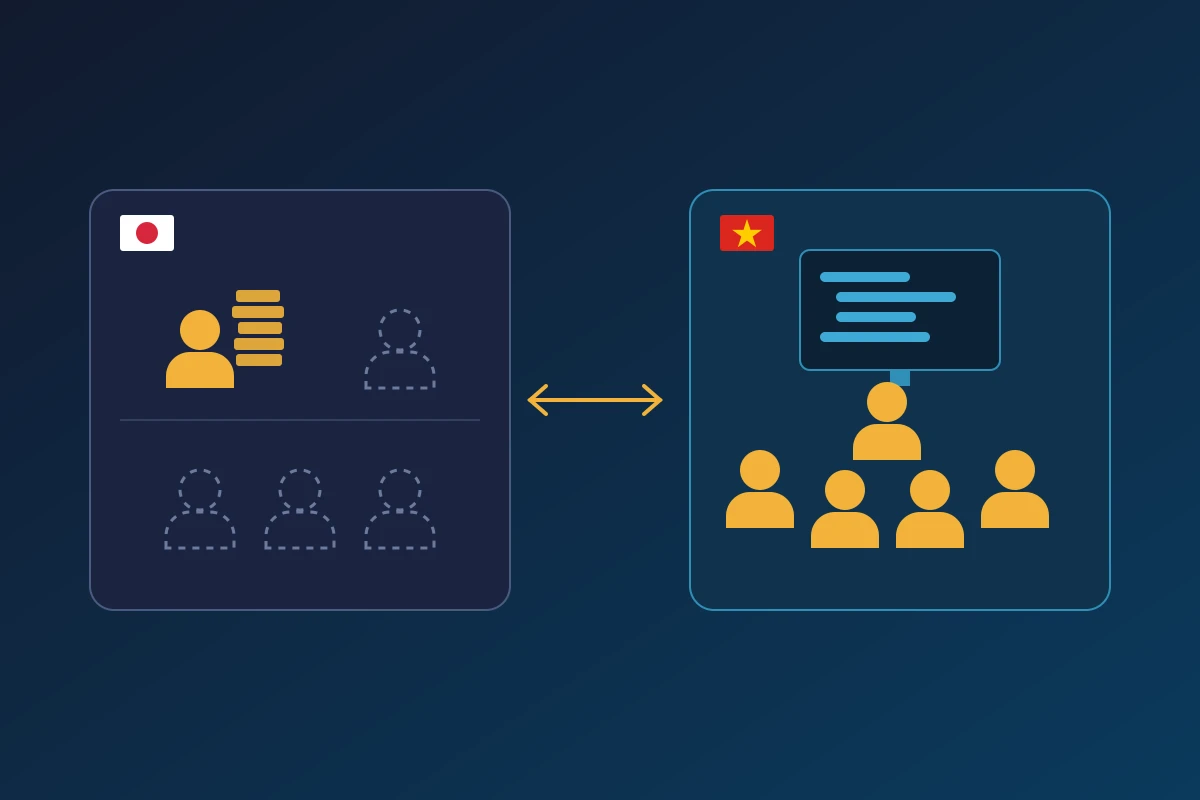
"We want to move forward with system development, but we can't hire engineers." "Our one in-house IT person is also handling maintenance." Comments like these now come from companies of every size and industry in Japan.
This article lays out the current state of the IT talent shortage, compares five responses companies can take, and explains how to pick a development setup that fits your situation.
The current state of the IT talent shortage
A survey commissioned by Japan's Ministry of Economy, Trade and Industry (METI), the "Survey on IT Human Resource Supply and Demand" (2019), estimates a shortfall of up to roughly 790,000 IT workers by 2030.
The list of IT themes companies must tackle keeps growing: digital transformation, cloud migration, generative AI. The number of engineers available to do that work has not kept pace. Many companies will recognise at least one of these situations:
- Job postings get few applicants, or the candidates' conditions don't match
- Even when someone is hired, ramp-up takes time and they aren't productive right away
- Only a few people understand the existing systems, so maintenance depends on individuals
- The same people handle new development and maintenance of legacy systems
Why hiring alone rarely solves it
The first response most companies reach for is stronger recruiting. Hiring matters, but relying on it alone runs into three problems:
- Intense competition: experienced engineers are wanted by many companies, and competing on compensation with large firms is not easy.
- Slow ramp-up: from hire to full productivity takes time, including learning the business and the internal systems.
- Hard to match demand swings: adding full-time staff for a busy development period leaves the question of where they go once the project ends.
A more realistic approach is to combine several measures alongside hiring.
Five responses to the IT talent shortage
1. Inventory and prioritise the work
Start by listing what the IT department is actually doing. Simply separating "work that must stay in-house" from "work that can be handed out" clarifies what kind of people you really need.
- Keep in-house: planning tied directly to business strategy, requirement decisions, security policy
- Easy to hand out: development with fixed specifications, testing, maintenance and operations, routine enhancements
2. Reskill existing staff
Have current employees learn IT skills. People who already know the business and then learn IT tend to drive system changes that fit the workplace. The downside is time: reskilling does not relieve a short-term shortage.
3. Use no-code and AI tools
No-code tools and generative AI can speed up simple business apps, document preparation and parts of coding. For core systems, large-scale development and systems with strict security requirements, you still need specialists for design, quality control and maintenance.
4. Outsource to a domestic partner
Contract development firms, staffing (SES) or freelancers. Communication in Japanese is smooth and business customs match. But engineers are scarce domestically too, so costs rise and the people you want may not be available when you need them.
5. Offshore development and lab-type development
Commission development to a company overseas. In particular, lab-type development, where a dedicated team is reserved for your company over a fixed period, suits companies that want to "keep people with the right skills available on an ongoing basis."
Details of how lab-type development works are on the lab development page.
Comparing the five responses
| Response | Time to ramp up | Best for | Watch out for |
|---|---|---|---|
| Work inventory | Short | Every company's first step | Doesn't add capacity on its own |
| Reskilling | Long | Leveraging business knowledge | Little help with short-term shortages |
| No-code / AI | Short to medium | Small process improvements | Limits for core systems |
| Domestic partner | Medium | Priority on Japanese language and business customs | Rising costs, availability not guaranteed |
| Offshore / lab-type | Medium | Securing ongoing development capacity | Communication structure must be designed deliberately |
In practice, most companies don't pick one. They split roles, for example "decisions and requirements in-house, development, testing and maintenance with an external team," and combine approaches.
Four points for successful offshore development
Common worries about offshore development are the language barrier and quality. These four points cut the risk substantially.
- Put a Japanese-speaking bridge in place: a Bridge SE (BrSE) who correctly understands requirements and conveys them to the development team is essential. The BrSE role is explained in this article.
- Start small: rather than handing over a large scope immediately, start with a few features or maintenance work, align on how to work together, then expand.
- Make requirements and acceptance criteria explicit: agreeing in advance on "what counts as done" prevents rework.
- Check the quality assurance setup: confirm the test plan, review structure and progress reporting before you commit. Having a team separate from development verify the work, known as third-party verification, is another option.
Concrete checkpoints for choosing a partner are collected in How to choose an offshore development company.
Why Vietnam is being chosen
More Japanese companies are choosing Vietnam as an offshore destination. The main reasons:
- Two-hour time difference: meetings and confirmations fit within Japanese business hours
- A large pool of young IT talent: many young people study IT, and the government treats it as a growth sector
- Many Japanese learners: with extensive trade with Japanese companies, there are people who can communicate in Japanese
- Track record with Japanese clients: many firms have long served Japanese companies
Details of offshore development in Vietnam are on the Vietnam offshore development page.
Frequently asked questions
How long will the IT talent shortage last?
METI's estimate points to a shortfall of up to about 790,000 people in 2030, and there is no sign of it resolving quickly. We recommend planning on a structure that includes external resources, not hiring alone.
Can a small company use offshore development?
Yes. Lab-type development can start with a small team, and many companies begin by handing over maintenance or a few features. Starting with a narrow scope and expanding once the working rhythm is settled is the realistic path.
Will communicating in Japanese be a problem?
Choose a partner with Japanese-speaking Bridge SEs and PMs and you can handle requirements, progress reports and defect communication in Japanese. When selecting a vendor, confirm that someone who can understand specifications in Japanese will actually be on your project.
How ARIS Vietnam can help
ARIS Vietnam is a Japanese-owned software development company with a base in Tokyo and development centres in Ho Chi Minh City and Hanoi. We build business systems, web and mobile applications, implement Odoo ERP, and provide QA and testing.
Our Japanese-speaking PMs and BrSEs can join from the requirements stage. Even if you are at the point of "we don't know where to start handing work out," we will listen to your current setup and challenges and propose a workable path.
Summary
- The IT talent shortage is expected to continue, and hiring alone is increasingly unlikely to solve it.
- The first step is to inventory the work and separate what stays in-house from what can be handed out.
- Combining reskilling, AI tools, domestic partners and offshore or lab-type development builds a sustainable development capacity.
- In offshore development, the BrSE structure, starting small and a solid QA process are the keys to success.
If you are weighing options for your development setup, please reach out via our free consultation.
Source: Ministry of Economy, Trade and Industry (commissioned to Mizuho Information & Research Institute), "Survey on IT Human Resource Supply and Demand," 2019
