The global semiconductor equipment market is under pressure. Demand for advanced packaging, AI chips, and next-generation wafer processing is surging — but the engineers who build the software inside these machines are getting harder to find, and harder to keep.
For Japanese semiconductor equipment OEMs, the math is straightforward: domestic software engineers cost ¥600,000–1,000,000 per person-month. A senior HMI developer with C++ and equipment control experience? Even harder to recruit in a market where every fab expansion competes for the same talent pool.
That's why a growing number of equipment makers are looking at Vietnam — not for generic outsourcing, but for specialised co-development of HMI, equipment control, host communication, and simulator software.
This article explains why Vietnam works for this niche, what to expect, and how to evaluate whether it fits your situation.
What "Semiconductor Equipment Software" Actually Means
When we say semiconductor equipment software, we're not talking about chip design or EDA tools. We mean the software layer that runs on the equipment itself:
- HMI (Human-Machine Interface): The operator screens that control the machine — displaying status, managing recipes, handling alarms, and logging process data. Modern HMI is moving from legacy desktop apps to web-based interfaces (ReactJS/TypeScript).
- Equipment Control Software: The logic that orchestrates hardware — motors, actuators, sensors — often communicating over industrial protocols like EtherCAT. Typically written in C/C++.
- Host Communication: SEMI-standard (GEM/SECS) interfaces that connect the equipment to the fab's MES (Manufacturing Execution System), enabling automated lot tracking and recipe management.
- Simulators: Software replicas of the machine's control environment, used for development and testing without requiring actual hardware.
Each of these layers has its own complexity. Together, they form a tightly integrated system where a small bug in one layer can halt a multi-million-dollar production line.
Why Vietnam — and Why Now?
Three factors make Vietnam a realistic option for this kind of work in 2026:
1. Cost structure that enables team-based co-development
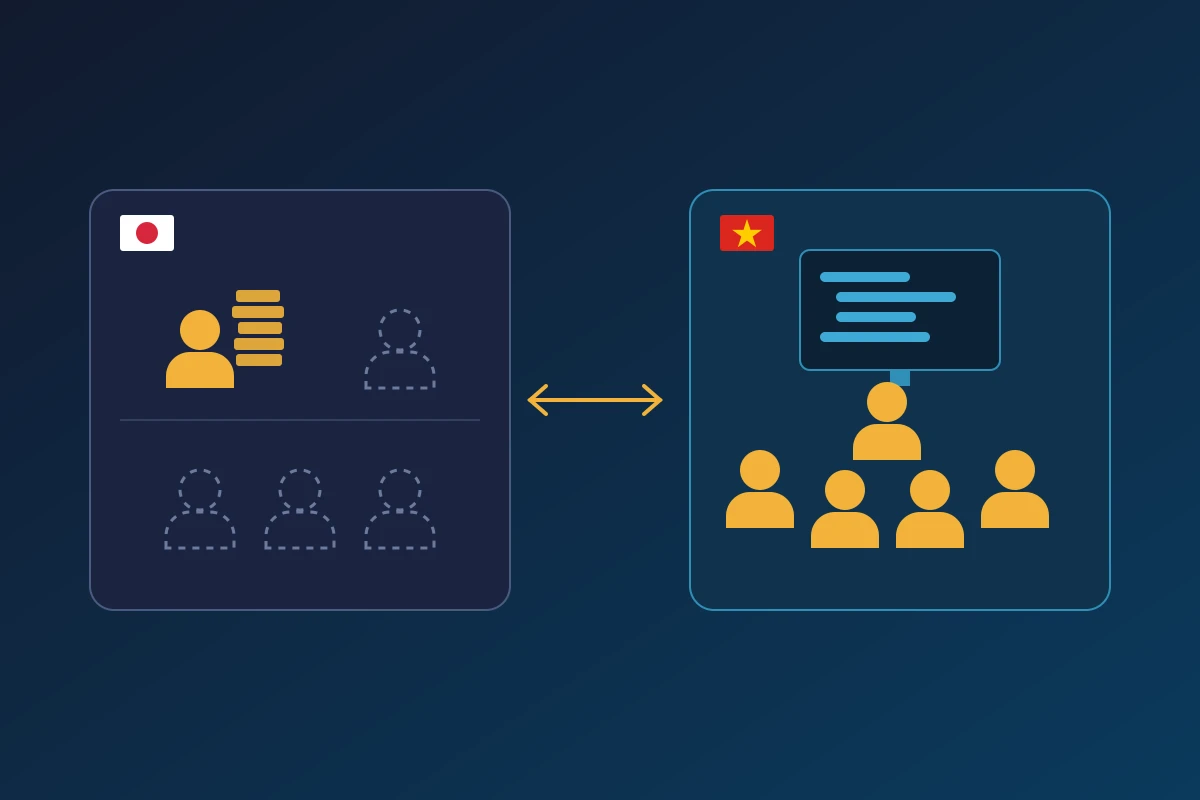
Vietnam's offshore development rates — roughly ¥400,000 for a programmer, ¥500,000 for a senior engineer — mean you can staff a 5–10 person team for the cost of 2–3 engineers in Japan. This matters because equipment software projects aren't about one brilliant developer; they're about sustained team effort across HMI, control, integration, and testing.
2. Japan-facing infrastructure already exists
Vietnam is Japan's largest software offshore destination, with over 40% of Japanese offshore budgets going to Vietnamese vendors. The ecosystem of bridge engineers (BrSE), Japanese-speaking project managers, and documentation processes built around Japanese quality expectations is mature. For semiconductor equipment software specifically, this means your specifications — often written in Japanese — can be received, discussed, and implemented without the translation friction you'd face with Indian or Eastern European teams.
3. Vietnam's semiconductor ambitions create a talent pipeline
The Vietnamese government's semiconductor development strategy targets 50,000 engineers by 2030. Universities are adding IC design, embedded systems, and industrial automation curricula. While most of this talent aims at chip design and packaging, the adjacent skills — C/C++, embedded systems, industrial protocols — directly feed into equipment software development.
What a Realistic Engagement Looks Like
Semiconductor equipment software is not a good candidate for "throw it over the wall" outsourcing. The domain knowledge is too specialised, the hardware dependencies too tight, and the quality requirements too strict.
What works instead is co-development — a model where the offshore team works alongside your engineering team, not as a black box.
Here's what this typically looks like:
Phase 1: Technical Survey & PoC (1–2 months) Before committing to a full engagement, the offshore partner reviews your existing architecture, communication interfaces, and development environment. A small proof-of-concept — such as an HMI screen prototype connected to a simulated control layer — validates whether the team can work within your technical constraints.
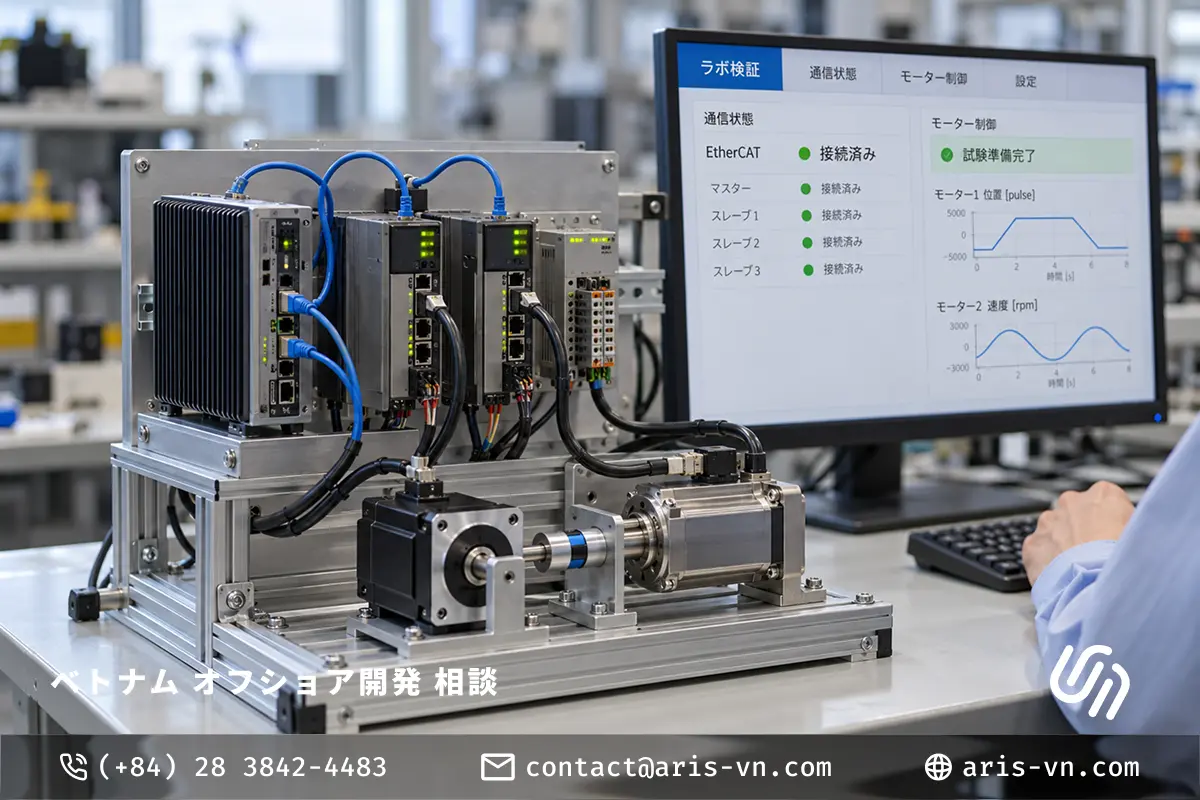
Phase 2: Lab-Based Co-Development (ongoing) The offshore team sets up a simulated hardware environment — for example, an EtherCAT master controlling slave devices and motors — to develop and test software without requiring access to your actual machine. This is critical: you can't ship a multi-hundred-million-yen production machine to Ho Chi Minh City, but you can replicate enough of its control topology to develop meaningful software.
Your Japanese engineers handle the hardware-dependent integration and final validation. The Vietnamese team handles the bulk of software development, testing, and documentation.
Phase 3: Integration & On-Site Verification Final integration testing happens on the real equipment, in your facility or your customer's fab. The offshore team supports remotely, with on-site visits as needed.
What to Check Before You Commit
Not every offshore vendor can do this work. Here's what separates a credible semiconductor equipment software partner from a generic outsourcing shop:
- Domain track record: Have they actually built HMI and control software for semiconductor equipment? Not "industrial software" in general — specifically the SEMI-standard, cleanroom-grade work.
- Simulated lab capability: Can they set up a hardware simulation environment, or do they need your physical machine to do anything?
- C++ and industrial protocol depth: Web development skills don't transfer here. You need engineers who understand real-time constraints, EtherCAT, and state machine design.
- Configurable software design: Equipment software needs to handle different wafer sizes, processes, and customer configurations. A team that hardcodes everything will cost you more in the long run.
- NDA and IP protection processes: You're sharing proprietary machine specifications. The partner needs mature information security practices, not just a checkbox on a sales deck.
The Bottom Line
Semiconductor equipment software development in Vietnam isn't for every project. If you need one person for three months to fix a legacy UI, hiring a domestic contractor is simpler.
But if you're facing a sustained need — building the next generation of your equipment's software platform, migrating from desktop HMI to web-based interfaces, or adding AI-driven process monitoring — then co-developing with a specialised team in Vietnam can deliver more output at lower cost, without sacrificing the quality your customers demand.
The key is choosing a partner with actual domain experience, not just headcount.
ARIS Vietnam has been developing semiconductor equipment software — including HMI, equipment control, host communication, and simulators for semiconductor manufacturing equipment — for over five years. Learn more about our semiconductor equipment software services →
Considering a PoC or lab-based co-development model? See our offshore development cost & rate guide →