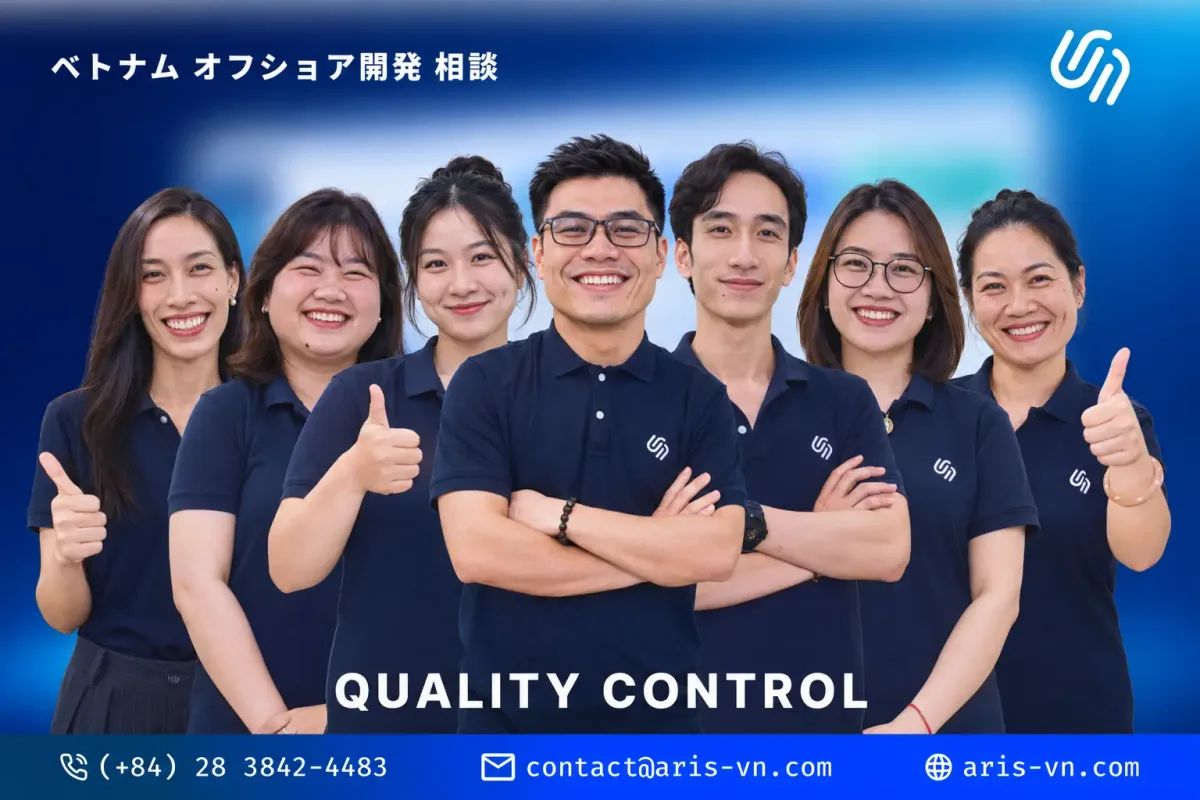
A conversation with the ARIS VIETNAM QC team
“I usually lose sleep on project release days.”
“And whenever we're sorting things out with a client.”
“When we take on a new project. Of course — right at the start!”
“So you're basically never sleeping?”
The group laughs quietly.
Today, we invite you to spend five minutes with the ARIS VIETNAM QC team, talking about responsibility, pressure, and the small joys that come with the work.
Testing semiconductor equipment: the most intense moments
Tom, you've worked on a lot of projects, including one for semiconductor equipment. For you personally, which moments felt the most intense?
Tom: I've been on the semiconductor project as QA/QC for a little over three years now. Before that, the work was handled by other colleagues. These days things are fairly stable, so we spend more of our time on review.
The stretch I remember most was the trips to test directly on the equipment. Each one was usually about two weeks, and I went quite a few times. There was a period when I really did spend a lot of hours on planes.
Around the same time I'd just had a small child, so balancing work with family time honestly wasn't easy. Preparing for each trip meant planning for things at home too.
But I had a lot of support from both the client and the company, so I gradually got everything sorted. So if you ask whether that was my most stressful period — I'm honestly not sure. Looking back, I remember far more of the good than the pressure.
From Operations to QC: learning Japanese on the project
Thanks, Tom. Peach, you joined the company in an Operations role, then studied Japanese, and you're now doing QC for the semiconductor project in Japan. What has that path been like for you?
Peach: Hello, everyone. When I started, I was learning Japanese from zero. The company supported me, so I had the chance to study and improve little by little. I've reached N1 now, but I'm still studying.
I feel lucky to have joined the semiconductor project and to keep learning through the project's documentation. Reading those documents, I pick up the specialist terminology and, at the same time, understand more about the system I'm testing.
Getting to use Japanese in my daily work also makes me want to learn more. Being able to read and understand the documents, then put that knowledge to work — that's genuinely satisfying.
Does the whole QC team need to speak Japanese?
So, to work with Japanese clients, does every member of the team need to know Japanese?
Peach: That depends on the project. On the team we have people at N1 and N2. There are also projects where the client communicates in English, or even in Vietnamese.
For projects that run in Japanese, the company has bridge engineers and comtors who help the team communicate with the client. The QC members work together with them to clarify anything that needs confirming.
As for the Japanese-study support, that's available to everyone at the company. People also get the chance to learn more about Japanese culture, so they understand how to work with clients better.
Three months in: pressure on a new QC member
Henny, I see you joined only three months ago. What does your work look like now? Is it stressful?
Henny: My work is mainly the tasks I'm assigned, with guidance and support from the senior members. There is some pressure, yes. I remember that in my very first two weeks, I was already responsible for checking a module in the factory's Audit system on my own.
At the time, a lot of the Safety terms were still new to me, and I didn't have a firm grasp of the domain yet. When I got to some of the formulas, it felt like being back in high school! (Laughs.)
So I worked and learned at the same time, and whenever something was unclear I went back and asked the seniors. Owning a piece of the work on my own was a little nerve-racking, but having people to support me made me feel much more secure.
When a client says they don’t understand
In the course of the work, have there ever been tense debates with the engineering team, the BA, managers, or even the client?
“Let Tom answer this one.”
“Right — Tom!”
Tom chuckles.
Tom: Debates inside the team happen all the time! But there's one exchange with a client I'll never forget.
We'd sent over our notes, with illustrations, and laid out the situations that could come up. I thought it was all fairly clear. The client replied with exactly one line: “I don't understand.”
That sentence really haunted me!
So what did you and the team do then?
Tom: We messaged the PM right away. The PM asked for some details, then set up a direct call with the client. Once we actually talked, the team finally understood what the client was really expecting.
Once we understood, everything was much easier to discuss. We carried the lesson from that time into other projects too. By now, clarifying the client's expectations has become a step in how the QC team works.
Staying steady when release day is close
And close to release, if there's still something you're not comfortable with, what do you do?
Another member: You have to say it early. Sometimes the part we just fixed passes testing, but I haven't finished checking the data from the older version. I flag that clearly so the PM and client know what's still left to do. If I need more time, I have to spell out exactly what I'll be checking in that window.
When a new fix comes in, the team re-checks both the bug that was fixed and the related parts. The important cases get added to the test suite, so next time something changes we can check them again.
The pressure is still there, especially when everyone is waiting on my results. But I can talk it through with the others and look at the sticking points together. Having someone work alongside me who understands the problem makes it far less tense.
Will AI replace the QC role?
What about AI? Do you think it will replace your work in the future?
A team member: I don't think AI will fully replace the QC role. I've worked on Machine Learning and Automation Test projects before. Today's AI can help speed up some stages of software development.
On projects where AI is allowed, we treat it as a partner we work alongside. The team decides which parts AI can help with, and then we check what it returns. For example, if AI suggests test cases, we still have to review whether those cases are complete and whether they match the project's business logic.
At the final checks, before the product reaches users, we are still the ones who verify the result and take responsibility for it.
Advice for anyone starting out in QC
Last 30 seconds — is there anything you'd like to pass on to others working in the same field?
A team member: This is a period when the IT field is changing very fast. We have to keep learning and trying new things too. But some things are still worth holding on to: working carefully, understanding exactly what you're doing, and taking responsibility for the result.
With anything new, I think it's best to stay open, learn about it, then verify it and weigh whether it actually fits your real work.
Thank you to Tom, Peach, Henny, and everyone in the ARIS VIETNAM QC team for taking the time to share.
Quality control: How QA/QC works in offshore development
Working with Japanese clients: Communicating effectively on offshore projects
AI in development: Why software outsourcing still matters in the AI era