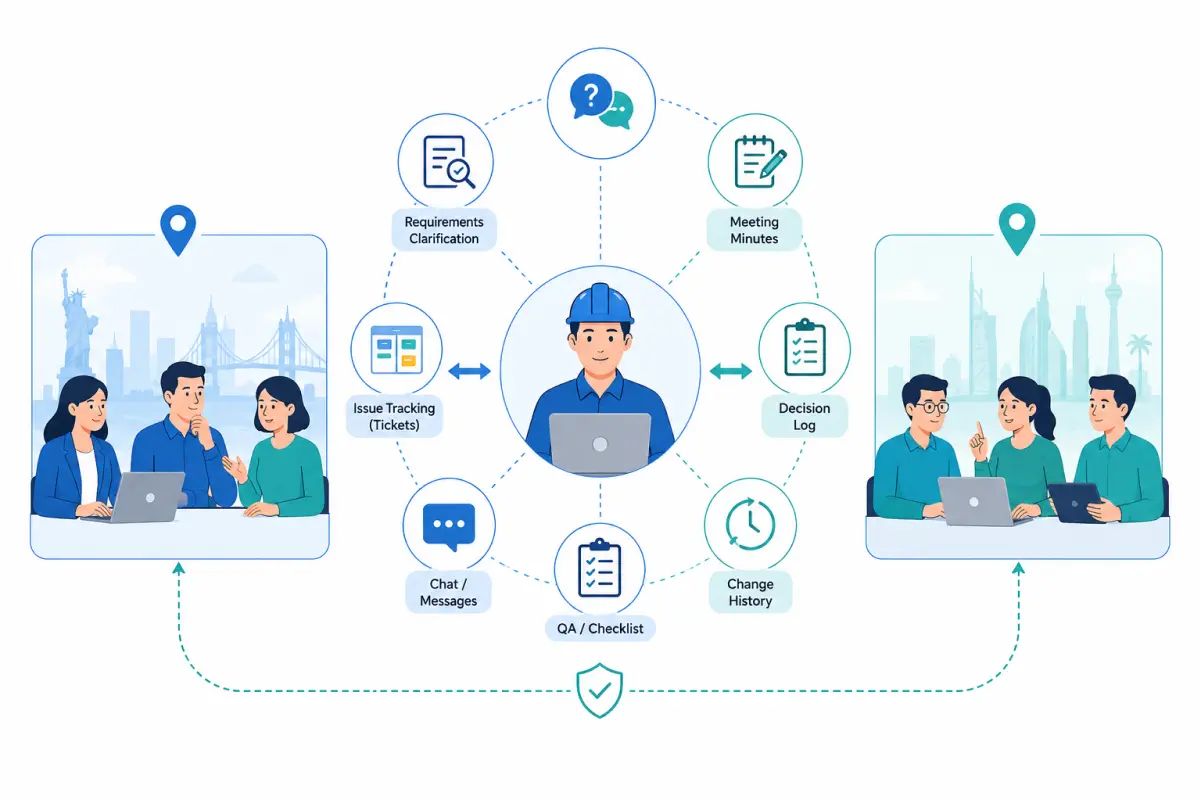
Communication is one of the most common challenges in offshore development. The issue is not only language. Cultural differences, business context, implicit assumptions and decision-making processes can all create misunderstandings.
In Japanese projects, expressions such as "please adjust it," "same as last time," or "make it easy to use" may be understood in context by domestic teams. For offshore teams, however, these expressions need to be clarified and documented.
This article explains communication challenges in offshore development, practical prevention methods and how ARIS Vietnam designs communication processes for Japan-oriented projects.
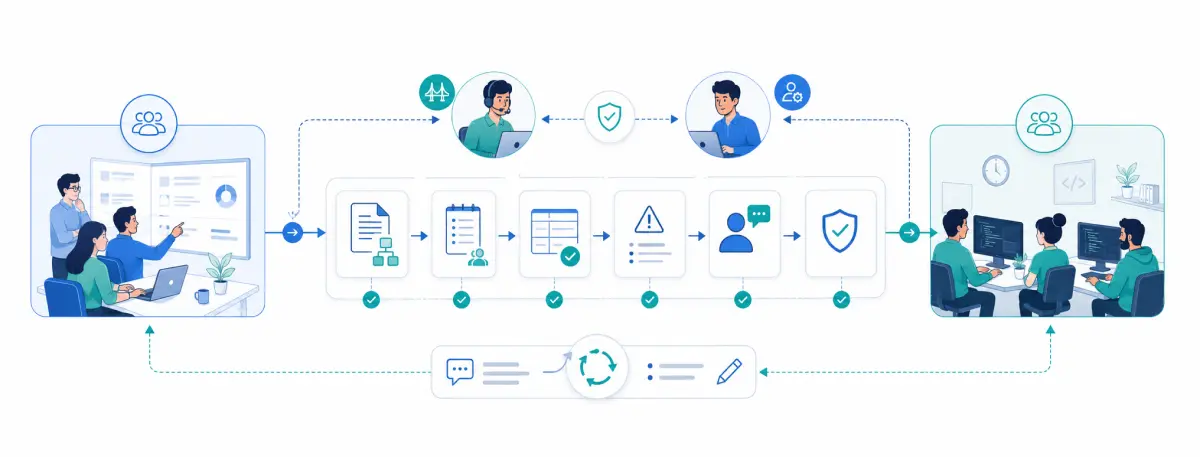
The real issue is misalignment of understanding
The biggest risk in offshore development is not simple translation mistakes, but misalignment of understanding. The customer may not explain assumptions that seem obvious. The offshore team may not know what should be confirmed. Meeting discussions may not be reflected in official specifications.
The solution is not simply to increase the number of meetings. Important information must be recorded in a way that everyone can understand, decisions must be clear, and changes must be traceable.
Offshore communication should be designed as a project process, not left only to individual language skills.
Common communication problems
- Meeting decisions are not reflected in minutes or specifications
- Ambiguous words such as "adjust," "handle" or "confirm" are misunderstood
- Exception cases and boundary values are not communicated
- Small chat requests become unofficial scope changes
- Decision makers are unclear and decisions are delayed
- Customer, bridge engineer, developers and QA have different understanding
- Problems are not escalated early
These issues cannot be solved only by holding more meetings. Teams need rules for organizing, recording, confirming and deciding information.
Basic rules to prevent misunderstandings
Requirements, specifications, decisions, issues and change history should be managed in one place. User stories, acceptance criteria, screen definitions, API specifications, permissions, error messages and test perspectives should be documented.
After meetings, minutes should clearly state decisions, open issues, owners and deadlines. A decision log helps the team understand why a certain specification was selected.
Role of bridge engineers and PMs
In Japan-oriented offshore development, bridge engineers and PMs are essential. A bridge engineer is not only a translator. The role is to understand business context, convert customer intention into implementable specifications, and communicate technical concerns from the development team back to the customer.
The PM manages progress, issues, risks, quality and team structure. When PM and bridge engineer work together, requirement understanding, visibility and decision speed improve.
Meeting and documentation design
Meetings should be designed by purpose. Daily meetings should focus on progress and blockers. Weekly meetings should review issues, risks, quality and schedule. Specification meetings should use concrete screens and data. Review meetings should confirm actual deliverables and collect feedback.
Documentation does not need to be heavy. The important point is that necessary information for development and testing is available, up to date and easy to confirm.
Tool usage
Tools such as Jira, Backlog, Redmine, Trello, Notion, Confluence, Slack and Teams can all be effective. The tool itself is not the key; the operation rule is.
Issue management should include status, owner, deadline, priority, reproduction steps and decision results. Chat is fast, but information can easily disappear. Important decisions should always be reflected in tickets or specifications.
ARIS Vietnam communication design
ARIS Vietnam designs communication as a repeatable process, not only as an individual skill. Japanese-capable PMs and bridge engineers manage meetings, minutes, issue tracking, progress reporting, specification confirmation and QA confirmation.
Based on experience with Japanese clients, ARIS does not simply accept ambiguous expressions. We clarify assumptions and convert them into specifications when needed. This reduces rework and improves project stability.
Value ARIS provides
- Japanese-capable PM and bridge engineer structure
- Documentation support for requirements, specifications and decisions
- Standardized issue management, reporting and risk control
- Coordination between specification confirmation and QA
- Technical proposals and risk sharing from the development side
- Communication support after release and during maintenance
If you are concerned about offshore communication, ARIS can help review your current project process and propose practical improvements.
Metrics for communication quality
Communication is often discussed subjectively, but improvement can be monitored with practical indicators. Examples include:
- Unresolved issues count
- Lead time for specification clarification
- Number of requirements that need reconfirmation
- Missing change records
- Rework count
- Open decisions after meetings
By monitoring these indicators, teams can identify where misunderstandings occur and what information is missing. Communication improvement is not about talking more; it is about making necessary information flow correctly.
Rules to decide at project start
Offshore projects become more stable when the following rules are agreed at the beginning.
- Where official specifications are recorded
- How change requests are approved
- Who handles urgent escalation
- Who converts chat decisions into tickets
- What each regular meeting is for
- When meeting minutes must be confirmed
- What responsibilities belong to the customer and offshore team
If these rules are unclear, information becomes scattered and decisions become slower as the project grows.
ARIS communication culture
ARIS values early confirmation, clarification of ambiguity, decision recording and issue visibility. These are essential for balancing quality and speed in Japan-oriented offshore development.
ARIS also shares technical risks and improvement proposals from the development side so that customers can make informed decisions. We communicate not as a passive vendor, but as a development partner that understands business objectives.
FAQ
Q1. Can ARIS help improve communication in an existing offshore project? Yes. ARIS can review meeting structure, issue management, documentation and decision flow, then propose improvements.
Q2. Is a bridge engineer always necessary? It depends on project size and language requirements, but for Japanese projects, a bridge engineer often reduces misunderstandings significantly.
Q3. Can ARIS use our existing tools? Yes. ARIS can work with tools such as Jira, Backlog, Teams, Slack and Confluence according to the customer environment.
Conclusion
Communication problems in offshore development cannot be solved by language skills alone. To prevent misunderstandings, teams need structured management of requirements, specifications, decisions, issues and changes, supported by bridge engineers, PMs and QA.
ARIS Vietnam supports not only software development, but also communication design, progress visibility, quality management and maintenance operations. If your offshore project has communication challenges, please contact ARIS.
