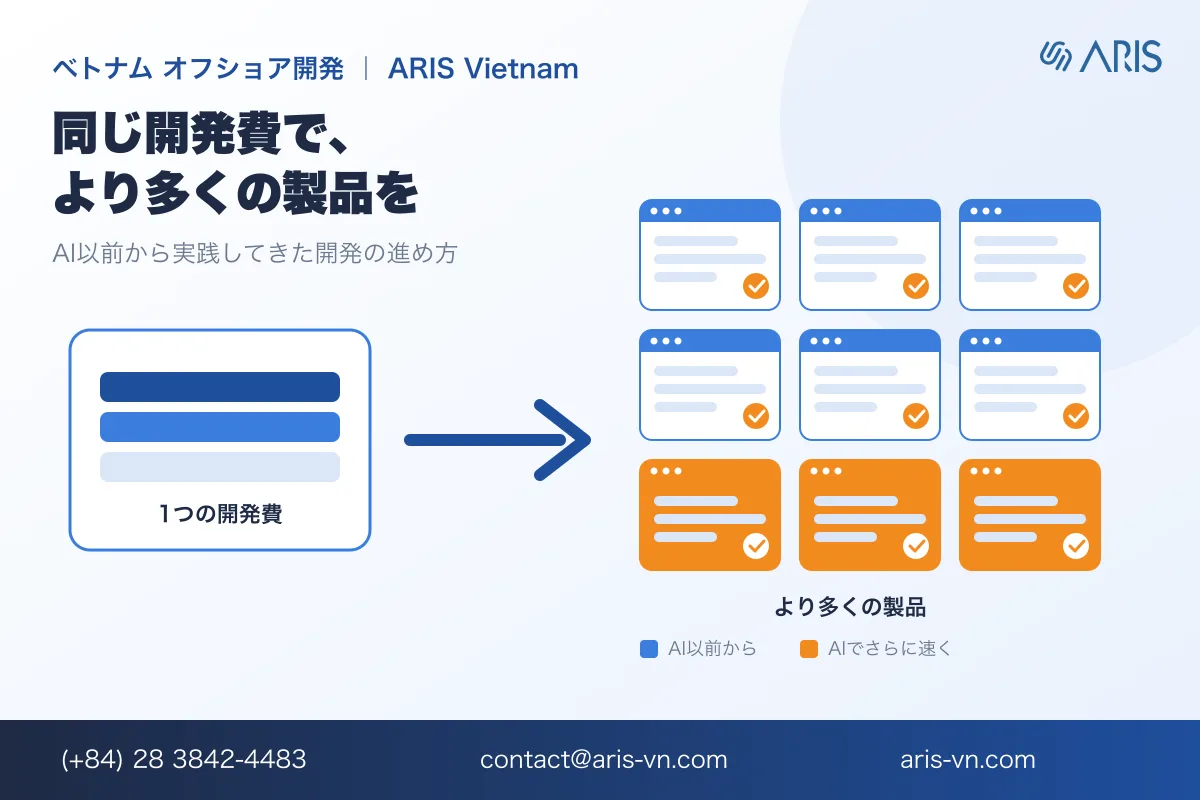
Since generative AI arrived, "doing more with the same budget" has become a constant topic.
I run the business development center at ARIS Vietnam and follow our projects with Japanese clients every day. From that seat, I can say that "same development budget, more products" is not an idea that was born with AI. We were building this way before AI existed, and we practiced it on real projects. AI does not change that direction. It helps us move faster along the same road.
This article covers four things:
- Our working philosophy
- How we practiced it before AI
- How we approach AI and the laws on AI and data
- Where AI still falls short, and what people must keep under control
To move fast, be transparent first
It is tempting to think that a faster project means working faster. Our experience says the opposite. If you want speed, start with transparency.
- Flag signals early. Risks, signs of delay and open questions are shared with the client as soon as we notice them. Early sharing creates room to respond without affecting the overall schedule.
- Stay close to the project and keep tending it. Waterfall or Agile, one thing never changes: we watch the project every day and solve small issues before they become big ones.
- Report with numbers and a proposal. A report never stops at "here is where we are". Progress, defect counts, remaining work and risk levels are shown in concrete numbers, together with what the issue is, what the options are and what we recommend, so the client can decide quickly and correctly.
- Make it work correctly, keep it stable, then optimize. Optimization only makes sense once a project is running reliably. We build that foundation first.
This is the working philosophy of ARIS Vietnam. Every practice below grows out of it.
How we practiced it before AI
With the same team, the number of products you can deliver in a year depends on the effort each one needs. To deliver more for the same budget, you have to cut wasted effort from each project, and the biggest waste usually comes from problems found late. On top of transparency, we applied five practices.
1. Clarify requirements at the start
Most waste in software comes from building the wrong thing and rebuilding it. Before the first line of code, our Business Analysts (BA) and Bridge SEs (BrSE) work with the client to define why we are building and what "done" means.
2. Keep the team stable, literally
Instead of rotating people per project, the same team stays with a client for the long term. They understand the systems, the business and how the client makes decisions, so each new project starts faster than the last. This is the thinking behind our lab development model.
"Stable" here is meant literally. Some clients started with a single project and are now on their teens with us. I have watched all of it from the same office. When they visit us in Ho Chi Minh City, they meet the engineers they worked with before, often the same team, and in most cases that team is still working on their projects today.
That is the ARIS philosophy.
3. Reuse what already exists
UI designs, functional components and test procedures from earlier projects are standardized and reused. For business systems, we build on existing platforms such as Odoo instead of starting from zero.
4. Cover everything from concept to operations
When one team handles analysis, design, development, testing and operations, no time is lost in handovers between companies. Issues found in operations feed straight into the next product.
5. Record and share knowledge
Design documents, key decisions and lessons from each project are kept so that knowledge does not depend on one person and carries over to new projects.
As mentioned above, some clients have built system after system with us over many years, from concept to operations. What made that possible was not a special tool. It was how we organize the work.
How we approach AI and the laws on AI and data
When generative AI appeared, we did not rush it into every project. We started with research, internal trials and study sessions to understand how AI can support software development.
At the same time, we have followed the legal landscape for AI and data in both Japan and Vietnam, because our clients are in Japan and our teams are in Vietnam.
| When | What |
|---|---|
| Sep 2025 | Japan: the AI Promotion Act takes full effect |
| Dec 2025 | Japan: the AI Basic Plan is approved by Cabinet (revised Jul 2026) |
| Jan 2026 | Vietnam: the Personal Data Protection Law takes effect |
| Mar 2026 | Vietnam: the Law on Artificial Intelligence takes effect |
| May 2026 | Vietnam: the implementing decree for the AI Law takes effect |
Japan's Act on the Protection of Personal Information remains the baseline whenever user data is involved.
Both countries are heading the same way: promote AI while protecting people and data. I see these rules not as barriers but as the ground rules that let clients entrust AI-assisted development with confidence. For more on AI and data handling in companies, see our comparison of cloud, local and hybrid AI.
Where AI still falls short, and what people must control
AI is useful, but not perfect. Hand everything to it and a project can get slower or riskier. We make sure people stay in control of six things:
- Understanding the requirement. AI does not know what the client really needs. Deciding what to build and what not to build stays with the BA, the BrSE and the client.
- Verifying the output and owning the result. AI can produce code or documents that look right and are wrong. Every output is reviewed by a person, and quality and final decisions remain a human responsibility whatever tool is used.
- Security. AI-generated code can contain vulnerabilities. Security review and testing are not optional. See how we manage quality.
- Client data. Our policy is not to put confidential client information or personal data into external AI services without permission.
- Rights. We pay attention to licensing and ownership of AI-generated code and content.
- Large, long-lived systems. On complex systems, AI cannot hold the whole context. The team's experience with that system matters even more.
For the role of offshore development in the AI era, see this article.
Conclusion
"Same development budget, more products" did not start with AI. It started with a working philosophy: transparency, early signals, staying close to the project, reporting with numbers and proposals. On that foundation sit concrete practices: clear requirements, stable teams, reused knowledge, and end-to-end delivery through operations. Make it work, keep it stable, then optimize.
AI helps us move faster along that road, as long as people understand the rules, protect the data and keep a firm hold on what AI still does poorly.
What I look at every day is not whether a team uses AI, but whether its way of working was sound before AI came in.
If your company has products waiting in a queue, contact us for a free consultation. We will work out where to start together.
References: Cabinet Office of Japan, "AI Act in full effect" (full effect 1 Sep 2025); AI Basic Plan (Cabinet decision 23 Dec 2025, revised 14 Jul 2026); Vietnam Law on Artificial Intelligence No. 134/2025/QH15 (effective 1 Mar 2026); Decree 142/2026/ND-CP (effective 1 May 2026); Personal Data Protection Law No. 91/2025/QH15 (effective 1 Jan 2026).
