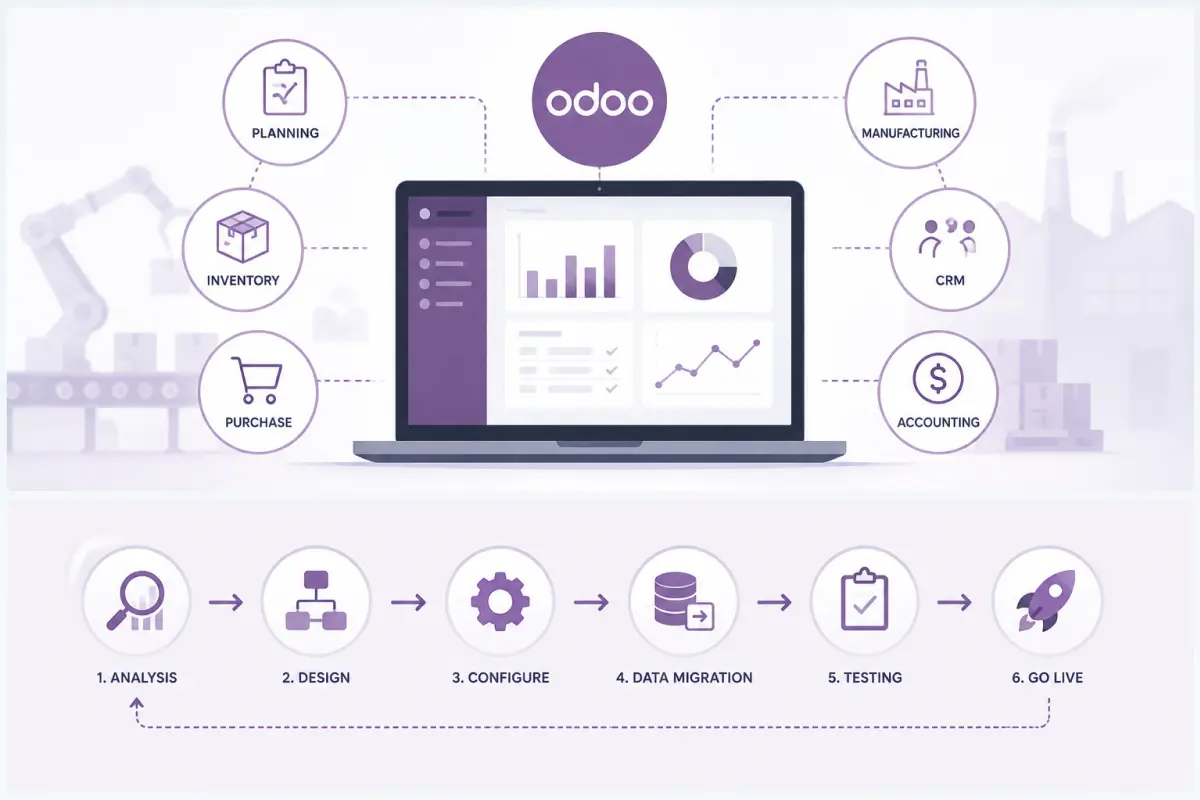
Many manufacturing companies operating in Vietnam still manage sales, purchasing, inventory, production, quality, and accounting through Excel files or separate systems. As businesses expand and factory operations become more complex, issues such as fragmented data, inventory discrepancies, unclear cost visibility, and manual approval processes often become major obstacles. This is why more companies are considering ERP implementation.
Among ERP options, Odoo is a strong candidate because it provides integrated business applications such as sales, purchasing, inventory, manufacturing, accounting, CRM, and HR.
However, while Odoo is flexible and feature-rich, successful implementation requires careful preparation, including business process review, Fit & Gap analysis, master data preparation, localization, and user adoption.
This article explains key considerations for Odoo implementation in Vietnam's manufacturing industry, common issues encountered during ERP consulting and deployment, and practical points for a successful rollout.
Why ERP Implementation Is Becoming Important for Manufacturers in Vietnam
In Vietnam's manufacturing sector, factory expansion, increasing customer requirements, fluctuating material costs, workforce turnover, and dependence on individual know-how can make Excel-based operations difficult to sustain.
The following issues are commonly seen in manufacturing companies:
- Each department manages its own Excel files or tracking sheets
- System inventory and actual inventory do not match
- Raw materials, work-in-process, and finished goods cannot be tracked in real time
- Production planning is not well connected with purchasing and inventory
- Manufacturing costs and profit margins are difficult to understand accurately
- Approvals and reporting are handled manually
- Reporting to the Japanese headquarters takes significant time
- It is difficult to balance local accounting/tax requirements with head office management reporting
In this situation, simply introducing a system is not enough. Companies need to review their business processes and create a structure for centralized data management.
Why Odoo Fits Manufacturing Operations
Odoo is an ERP platform that can integrate multiple business areas such as sales, purchasing, inventory, manufacturing, accounting, quality, maintenance, HR, and CRM. For manufacturers, it helps manage the flow from sales orders and purchasing to inventory, production, delivery, invoicing, and accounting in a more connected way.
Connecting Sales, Purchasing, Inventory, and Manufacturing
In manufacturing, sales orders, purchasing, warehouse inventory, and production instructions are closely related. With Odoo, data from sales, purchasing, inventory, and manufacturing can be managed on the same platform, making it easier for departments to share information.
Improving Visibility of Production and Inventory
By organizing manufacturing orders, bills of materials, operations, work centers, and stock moves, companies can better understand where products are in the production process and which materials may be missing. This helps identify production delays, material shortages, excess inventory, and inventory discrepancies earlier.
Supporting a Phased Implementation Approach
Because Odoo consists of multiple business applications, it is possible to start with sales, purchasing, and inventory, then expand to manufacturing, quality, and accounting in later phases. For companies with limited ERP experience, this phased approach reduces operational burden and supports smoother adoption.
Key Points in Odoo Implementation Consulting
Odoo implementation is not only about system configuration or development. Business process review and Fit & Gap analysis before implementation are critical. In manufacturing, each factory or production line may have different rules, so it is necessary to decide carefully which processes should follow Odoo standard functions and which require customization.
Visualizing Current Business Processes
Before implementation, the workflows for sales, purchasing, inventory, manufacturing, quality, and accounting should be documented. It is important to clarify who enters which data, when data is entered, what reports are required, and which approvals are needed. This makes it easier to decide what should be systemized and what should remain as operational procedures.
Fit & Gap Analysis
Fit & Gap analysis identifies which requirements can be covered by Odoo standard functions, which can be handled through configuration, and which require customization. If companies try to reproduce all existing processes exactly as they are, customization increases and may impact cost, schedule, and maintainability.
Therefore, it is important to distinguish between processes that can be adjusted to Odoo standards and requirements that are truly necessary for business operations.
Scope Definition and Phase Planning
For manufacturing ERP projects, implementing sales, purchasing, inventory, manufacturing, quality, accounting, and HR all at once can create a heavy burden on the organization. A more realistic approach is to begin with core operations such as inventory, purchasing, and sales, and later expand to manufacturing, quality, costing, and accounting integration.
Common Challenges in Odoo Implementation
Odoo is a flexible ERP system, but to implement it successfully, companies need to understand the following challenges in advance.
1. Master Data Preparation Takes Time
Master data preparation is one of the most important tasks in ERP implementation. Products, parts, raw materials, vendors, customers, warehouses, locations, units of measure, bills of materials, operations, work centers, and chart of accounts must be properly prepared. Without clean master data, accurate inventory and production management in Odoo becomes difficult.
When companies have relied on Excel or individual management styles, duplicate item codes, inconsistent naming, different units of measure, and outdated data are common problems.
2. Bills of Materials and Routing Design Can Become Complex
In manufacturing, it is important to decide how to represent bills of materials, alternative parts, yield loss, operations, subcontracting, and work-in-process management in Odoo. If every detail from the shop floor is systemized, operations may become too complex. On the other hand, if the design is too simplified, the information needed for costing and production progress management may be insufficient.
For this reason, the appropriate level of control should be decided based on the actual business objectives.
3. Low Inventory Accuracy Reduces ERP Effectiveness
Even after ERP implementation, if actual inventory and system inventory differ significantly, accurate production and purchasing plans cannot be created. Before or during the early implementation phase, companies should review stocktaking rules, inbound/outbound procedures, location management, barcode operations, and approval authority to improve inventory accuracy.
4. Vietnamese Accounting and Tax Requirements Need Careful Review
When implementing ERP in Vietnam, companies need to consider local accounting, tax requirements, e-invoices, audit requirements, and management reporting to the Japanese headquarters. It is necessary to decide whether to use Odoo Accounting, integrate with local accounting software, or export separate reports for head office management.
For Vietnam-specific operations, localization should be considered together with business processes, forms, data export, and reporting requirements.
5. It Is Difficult to Decide Between Standard Functions and Customization
Odoo can be customized flexibly, but excessive customization increases implementation cost, maintenance cost, and the burden of future upgrades. At the same time, manufacturing companies often require unique approval flows, reports, costing rules, subcontracting processes, or quality records that cannot always be covered by standard functions alone.
Customization decisions should be based on business necessity, future maintainability, operational burden, and cost-effectiveness.
6. User Adoption on the Shop Floor Takes Time
ERP implementation requires cooperation not only from management and administrative departments but also from warehouse staff, production teams, purchasing teams, and quality control staff who use the system every day.
When operations have been handled by Excel or paper, changes in input rules and approval processes may create resistance. Manuals, training, pilot operation, and feedback from users are important for gradual adoption.
7. Requirements Differ Between the Japanese Headquarters and the Vietnam Subsidiary
For Japanese manufacturers in Vietnam, the indicators required by the head office may differ from the information needed for daily operations at the local factory. The head office often focuses on monthly reports, costs, inventory value, profitability, and internal controls, while the factory focuses on receiving, issuing, production progress, material shortages, work instructions, and quality records.
Odoo implementation should balance both management reporting and shop floor operations.
Recommended Approach for Successful Odoo Implementation
To implement Odoo successfully, companies should avoid assuming large-scale customization from the beginning. Instead, they should focus on business process review, effective use of standard functions, phased implementation, and user adoption.
Phase 1: Current State Analysis and Business Process Review
Review current workflows, Excel files, reports, existing systems, business issues, and management indicators. At this stage, the goal is not only to discuss system functions but also to clarify what information is needed and which processes should be improved.
Phase 2: Fit & Gap Analysis and Implementation Policy
Identify what can be handled by Odoo standard functions, what can be addressed through configuration, and what requires customization. At the same time, define target departments, data migration scope, permissions, approval flows, reports, and external integrations.
Phase 3: Configuration, Customization, and Data Migration
Configure Odoo, develop necessary customizations, prepare master data, and migrate existing data according to the agreed implementation policy. Testing should be conducted based on real business scenarios to find operational issues early.
Phase 4: Training and Pilot Operation
Provide training to end users and conduct pilot operation close to actual work. Training should explain not only how to use screens but also which data should be entered, when, and for which business process.
Phase 5: Go-Live and Continuous Improvement
After go-live, support inquiries, check data quality, adjust operational rules, and implement additional improvements. ERP delivers greater value when it is improved continuously after implementation.
ARIS Vietnam's Odoo Implementation Support
ARIS Vietnam supports manufacturing companies in Vietnam with Odoo consulting, requirement definition, Fit & Gap analysis, configuration, customization, data migration, training, and post-implementation maintenance.
With experience in software development for Japanese companies, ARIS can support implementation from both the perspective of the Japanese headquarters and the Vietnam local subsidiary.
Main Areas ARIS Can Support
- Business interviews and current state analysis before Odoo implementation
- Review of sales, purchasing, inventory, manufacturing, and accounting operations
- Fit & Gap analysis against Odoo standard functions
- Implementation scope and phased rollout planning
- Odoo configuration and customization
- Master data preparation and data migration support
- Forms and approval workflows aligned with Vietnam operations
- Reports and management materials for the Japanese headquarters
- User training and manual preparation
- Post-implementation maintenance and improvement
Key Focus Points for Manufacturing Companies
- Designing processes at a practical level for shop floor operation
- Reducing excessive customization by using standard functions effectively
- Improving inventory accuracy through clear operational rules
- Gradual preparation of bills of materials, routing, and costing
- Designing reports for both the Japanese headquarters and the Vietnam subsidiary
- Building a support structure for continuous improvement after implementation
Conclusion
Odoo implementation for manufacturing companies in Vietnam is an effective way to integrate sales, purchasing, inventory, production, quality, and accounting, and to enable data-driven factory management.
However, successful ERP implementation requires more than system functions. Business process review, master data preparation, Fit & Gap analysis, decisions on standard functions and customization, user adoption, and localization are all essential.
Manufacturing operations are especially complex because of bills of materials, routing, inventory, costing, quality control, and subcontracting. Therefore, consulting before implementation and a phased rollout plan are critical.
ARIS Vietnam supports Odoo implementation for manufacturers in Vietnam from business analysis to configuration, customization, data migration, training, and ongoing maintenance.
If your company is considering process improvement, inventory management improvement, production visibility, or ERP implementation for a factory in Vietnam, please feel free to contact us.
