
Introduction
When you look into offshore development, two contract models come up almost every time: lab-based development and fixed-scope (contract) development. Both hand development to an overseas partner, but they differ in how the contract works, how costs are set, and how well they handle changing requirements.
This article explains what lab-based development is, how it differs from fixed-scope contracts, how to think about cost, and which projects it suits. For the bigger picture, see What Is Offshore Development? Benefits, Costs and Process.
1. What is lab-based development?
Lab-based development means reserving a dedicated team at an overseas partner for a set period and developing continuously while you adjust priorities. It is also called an "offshore development center" (ODC).
It is usually contracted on a time & material (T&M) basis. You pay for the team's work over the period, not for a finished deliverable, so you can change which features are built, and in what order, without renegotiating the contract.
2. How it differs from fixed-scope development
The other common model is a fixed-scope contract, where the partner commits to completing an agreed deliverable. Specification, schedule and price are fixed up front.
| Item | Lab-based (T&M) | Fixed-scope |
|---|---|---|
| What is promised | Work performed over a period | Completion of an agreed deliverable |
| How cost is set | Team size and roles × duration | Fixed price for the agreed scope |
| Changes | Absorbed by re-prioritising the backlog | Usually require a new estimate or contract change |
| Completion responsibility | Partner works with due care but does not guarantee completion | Partner guarantees completion and fixes defects |
| Client involvement | Ongoing: priorities and acceptance | Mainly requirements and acceptance |
| Best for | Evolving requirements, continuous improvement, long-term products | Systems with clear requirements, scope and deadline |
3. Advantages
Handles changing requirements well
When you want to add features based on market feedback, or priorities are likely to shift, there is no need to re-estimate and re-contract for every change. Reordering the backlog is enough.
Knowledge stays with the team
The same people stay on the project, so their understanding of the system and business rules keeps growing, and ramp-up and handover time drops.
Steady access to scarce skills
You can secure roles that are hard to hire locally as a stable team for a set period.
4. Things to watch
The client must make decisions
In a lab model, the client decides what to build and in what order. Without a product owner who sets priorities, work starts and stops and the team's capacity is wasted.
You pay for idle time too
Cost accrues for the period the team is reserved. Keep a monthly plan and a ready backlog.
Quality is secured through process
Under T&M the partner does not guarantee completion, so agree on a Definition of Done, review rules and weekly reporting from the start.
Route instructions through the partner's PM or BrSE
Direct instructions to individual engineers can blur legal roles in some jurisdictions. Channel requests through the partner's PM or bridge SE and define responsibilities in the contract. See What Is a Bridge SE (BrSE)?.
5. How to think about cost
Monthly cost = each member's monthly rate × headcount (+ PM, BrSE, QA roles)
Multiply by the contract period for the total. When comparing quotes, also check which roles are included, what drives the rates (tech stack, experience, Japanese ability, seniority mix), how the ramp-up period is handled, and how much of your own team's time the model needs. Fixed-scope quotes often include a risk margin for uncertainty; a lab model does not, but the total depends on how well it is run. Compare total cost, not rates alone.
6. When it fits, and when it doesn't
Good fit: continuous improvement after an MVP, a long-term roadmap, frequent or unclear requirement changes, maintenance plus feature work by one team.
Poor fit: clear requirements with a fixed budget, no one on your side to set priorities, short projects with little expected change. For these, fixed-scope delivery is usually better.
7. You can combine both
Start with a PoC or a small fixed-scope project, carve out well-defined features as fixed-scope work while the lab handles continuous improvement, or run maintenance and improvements in one lab. See also Agile in Offshore Development.
8. Lab-based development at ARIS Vietnam
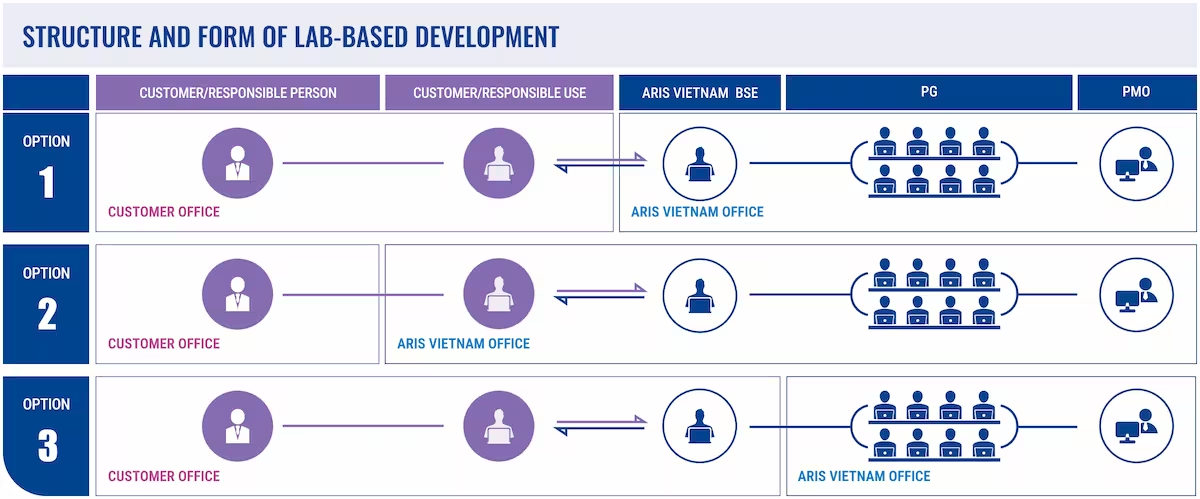
ARIS Vietnam runs lab teams from its Ho Chi Minh City and Hanoi offices, with Japanese-speaking PMs and BrSEs as the point of contact. As the diagram above shows, the placement of BrSE, developers and PMO can be matched to how your team works. Meeting minutes, issue and risk tracking, change management, a Definition of Done and weekly reports are standard, so the team stays flexible without losing control. A typical start is a one-to-three-month ramp-up, after which you decide whether to continue.
Details: Lab-based Development (T&M).
Summary
- Lab-based development reserves a dedicated team for a period and is usually contracted on a T&M basis.
- Fixed-scope contracts promise a finished deliverable and suit projects with clear requirements.
- Labs handle change well but need decisions from the client and a process that secures quality.
- Cost is basically rate × headcount × duration; compare roles included and your own effort too.
Not sure which model fits your project? Contact us for a free consultation.
