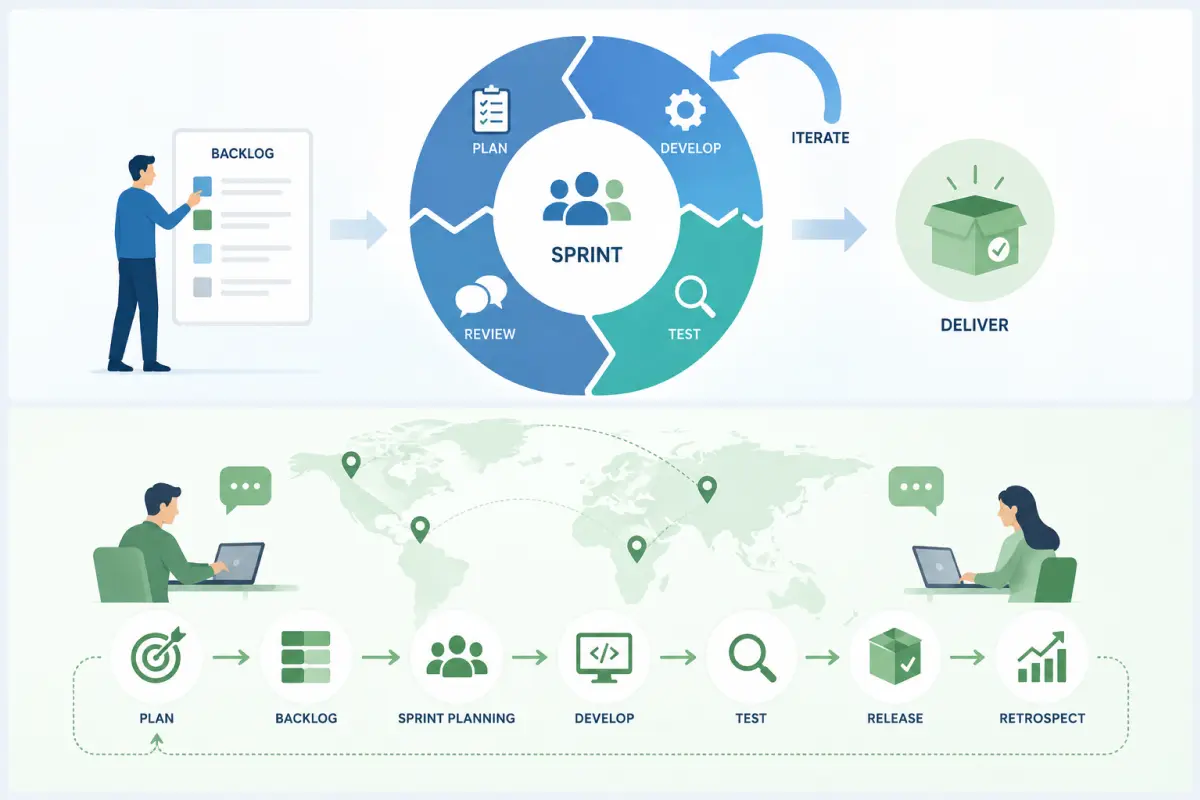
In new service development, digital transformation and continuous system improvement, it is becoming harder to define all requirements perfectly at the beginning. Agile development is suitable for such situations because it allows teams to build in short cycles, review early and improve based on feedback.
However, when agile is combined with offshore development, many companies worry about distance, communication, language, quality and sprint management. Agile offshore development can work very well, but only when the team structure, backlog, QA and communication rules are designed properly.
This article explains how to make agile development work in an offshore environment and how ARIS Vietnam supports agile offshore delivery.
What is agile development?
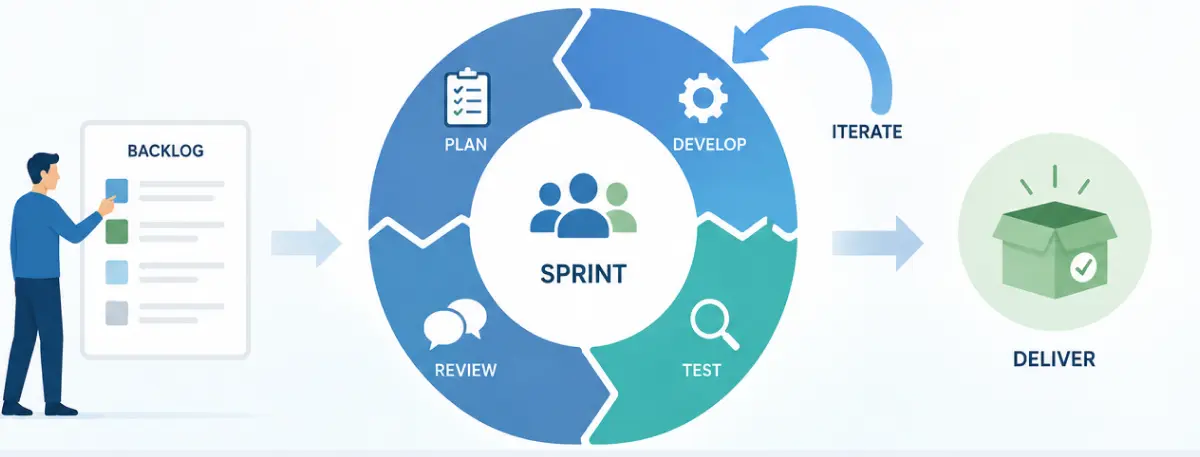
Agile development is a method of building software through short development cycles, often called sprints. Instead of fixing every requirement at the beginning, teams prioritize valuable features, develop them in small units, review outcomes and adjust priorities based on feedback.
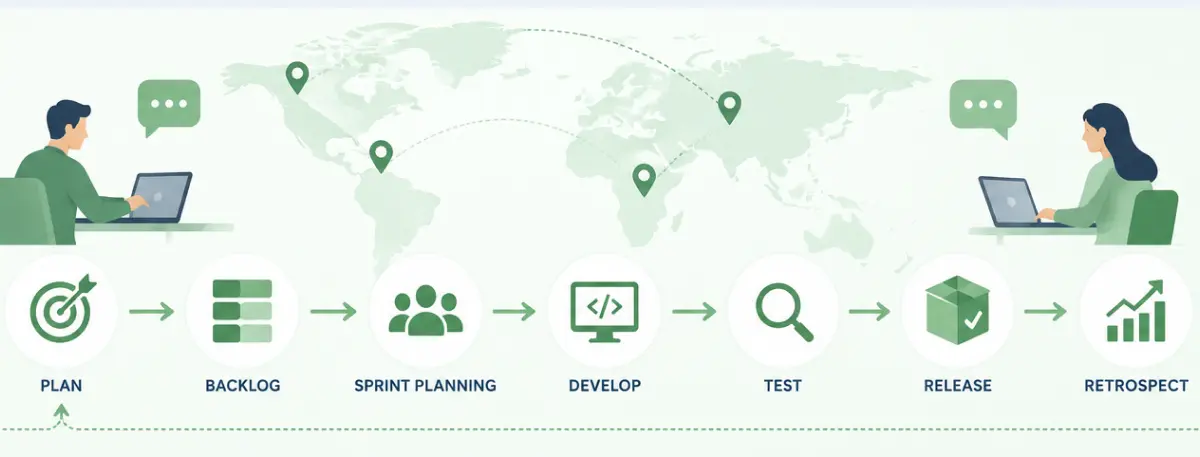
Scrum is one of the most common agile frameworks. It uses product backlog, sprint planning, daily meetings, sprint review and retrospective to continuously improve both the product and the development process.
Why agile is effective in offshore projects
Offshore development involves distance, language and cultural differences. These factors can create misunderstandings if the team works for a long time without checking intermediate outputs. Agile reduces this risk by enabling frequent review.
When the team checks screens, APIs and functions at the end of each sprint, specification gaps can be discovered early. Small deliveries and quick feedback help reduce rework and improve both quality and speed.
The purpose of agile offshore development is not simply to work faster. It is to discover misunderstandings early and deliver business value step by step.
Common failure patterns
Agile does not succeed automatically. In offshore projects, failure often occurs when the process is not disciplined enough.
- The backlog is not organized and priorities change every week
- User stories do not include acceptance criteria
- Sprint reviews are only formal meetings without real feedback
- Business-side confirmation is delayed
- QA is performed only at the end of the sprint
- Many meetings are held but decisions are not recorded
Agile does not mean that documentation is unnecessary. On the contrary, short-cycle development requires clear priorities, acceptance criteria, decision logs and test perspectives.
Team structure required for success
Agile offshore development requires clear roles. The product owner decides business priorities. The PM or Scrum Master manages progress, issues and risks. The bridge engineer aligns understanding between the customer and the offshore team. Developers implement and propose technical solutions. QA members confirm quality from the requirement stage.
| Role | Main responsibility |
|---|---|
| Product Owner | Business objective, priority and acceptance decisions |
| PM / Scrum Master | Sprint management, issues, risks and progress |
| Bridge Engineer | Requirement clarification and communication alignment |
| Developers | Design, implementation, unit testing and technical proposals |
| QA | Test design, acceptance criteria validation and regression testing |
Backlog and acceptance criteria
The quality of the product backlog directly affects project quality. A backlog item such as "build search function" is not enough because each stakeholder may imagine different behavior.
A good user story should clarify the user, purpose and expected outcome. Acceptance criteria should describe normal cases, error cases, permissions, messages, boundary values and UI behavior. This allows developers and QA to work based on the same standard.
QA must be included in every sprint
To maintain quality in agile offshore development, QA should not be treated as a final phase. QA should participate before sprint development starts, review acceptance criteria, prepare test cases and validate functions within the sprint.
For continuously evolving systems, regression testing and test automation are also important. If every release depends only on manual testing, the testing effort will increase as the system grows.
How ARIS Vietnam supports agile offshore development
ARIS Vietnam supports agile offshore development for web systems, mobile apps, business systems, admin portals and API platforms. We support not only coding, but also requirement clarification, backlog preparation, sprint operation, bridge engineering, QA/test design and post-release improvement.
Our experience with Japanese clients allows us to manage communication carefully, visualize progress and reduce misunderstandings between business and development teams.
Value ARIS provides
- Support from MVP development to full-scale service development
- Product backlog, user story and acceptance criteria preparation
- PM and bridge engineer structure for Japanese/English communication
- Sprint-based progress, issue and quality visualization
- QA integrated into the agile process
- Continuous maintenance and improvement after release
If you want to apply agile development in an offshore environment but are concerned about management and communication, ARIS can help you start with a small MVP or improvement project.
Check whether agile is suitable
Agile is not the best answer for every project. It works well for products that need user feedback, MVP development, systems with changing requirements and web or app services that require continuous improvement.
For systems with highly fixed requirements, strict regulatory specifications or very small short-term scopes, a waterfall or hybrid model may be more suitable. The important point is not to choose agile as a trend, but to select the process that fits the business objective and risk profile.
ARIS hybrid agile approach
For Japanese clients, a hybrid approach is often practical. In this model, key requirements, core design, roles, data, permissions, integrations and quality standards are clarified first. Then development is performed in sprints based on priority.
This approach combines the planning discipline expected by Japanese companies with the flexibility of agile development. It also makes offshore communication easier because the team has a shared baseline before sprint execution begins.
Agile operation checklist
- Product Owner is clear and can decide priorities
- Backlog is organized by business value
- User stories and acceptance criteria are defined
- Sprint review confirms actual deliverables
- QA participates before sprint development starts
- Important decisions are recorded in a decision log
- Velocity, issue count and quality status are monitored
If your organization is unsure about these points, ARIS can help design the agile operating model before development begins.
FAQ
Q1. Can we start agile if our team is not experienced? Yes. ARIS can support backlog creation, sprint design, review process and QA integration.
Q2. Can requirements change during development? Yes. Changes can be handled through backlog prioritization and sprint planning. Impact and additional effort should be confirmed each time.
Q3. Can agile work with fixed estimates? Pure agile is more suitable for time-and-material or dedicated teams, but phase-based scope control can make budget management easier.
Conclusion
Agile offshore development can improve speed, flexibility and quality when operated correctly. However, without backlog discipline, acceptance criteria, QA and decision management, it can easily become chaotic.
ARIS Vietnam supports companies that want to build flexible offshore development teams for MVPs, new digital services, mobile apps and continuous system improvement. If you are looking for an agile offshore partner, please contact ARIS.
