
The success of offshore development depends not only on the country you choose, but more importantly on the partner you select. Even within the same offshore destination, vendors differ greatly in technical capability, quality management, communication style, proposal quality and maintenance support.
If a company selects a vendor only by the lowest estimate, communication gaps and quality problems can appear during development. The final cost may become higher than expected due to rework and delays. For Japanese companies, Japanese communication, business understanding, quality standards and long-term support are especially important.
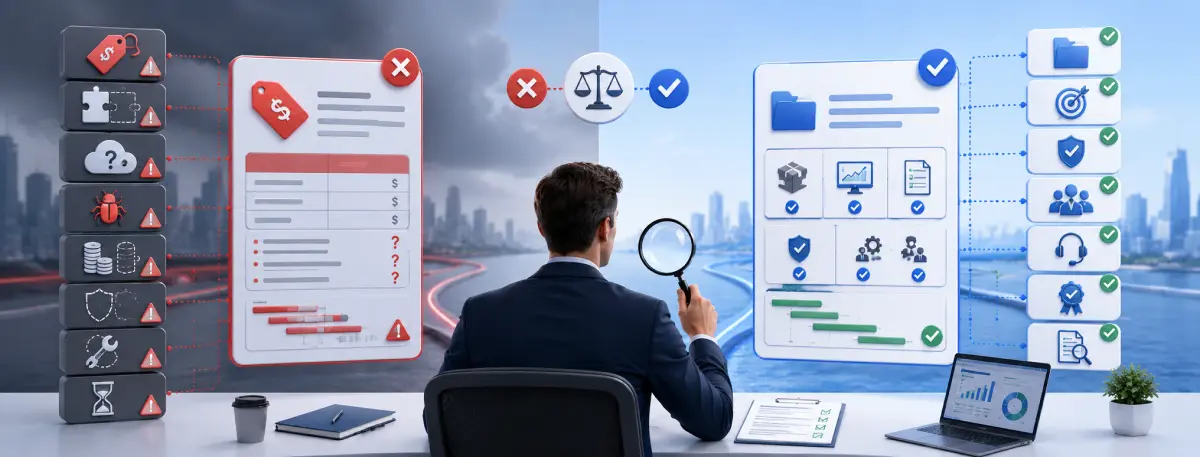
This article explains how to evaluate offshore development vendors, how to read proposals and estimates, and how ARIS Vietnam supports customers as a long-term development partner.
Why vendor selection matters
An offshore vendor is not just a resource provider. A reliable partner understands requirements, makes technical decisions, controls quality and supports continuous improvement after release. If selection criteria focus only on price, important project risks can be missed.
A good vendor does more than implement requested functions. It points out unclear requirements, explains operational risks and proposes better implementation approaches. A vendor that begins development without sufficient clarification may create large rework later.
Common mistakes in vendor selection
- Selecting only by the lowest unit price
- Not checking technology stack and similar project experience
- Ignoring Japanese/English communication capability
- Not confirming PM, bridge engineer and QA involvement
- Leaving security and access control until later
- Not confirming post-release maintenance support
- Accepting abstract proposals because the price looks attractive
To avoid these mistakes, companies should check whether the vendor can be trusted continuously, not only whether it can write code.
Vendor evaluation checklist
| Evaluation item | What to check |
|---|---|
| Technical capability | Languages, frameworks, cloud, mobile and system experience |
| Business understanding | Experience in business systems, inventory, order, accounting, HR or platform systems |
| Communication | Japanese/English communication, bridge engineer, meetings and issue management |
| Quality management | Code review, test design, QA team and bug tracking |
| Project management | WBS, sprint management, reports, risk control and visibility |
| Security | NDA, access control, development environment and information management |
| Maintenance | Post-release support, minor enhancements, documentation and operations |
Using this checklist helps compare vendors beyond price.
For a starting shortlist, see our comparison of 10 software development companies in Vietnam, which lists each company's founding year, Japan offices and certifications.
How to read estimates and proposals
A proposal shows how well the vendor understands the project. A low estimate may be risky if assumptions are unclear or if testing, project management and QA effort are not included.
Companies should check scope, assumptions, exclusions, responsibilities, deliverables, test coverage, warranty period and maintenance conditions. If requirements are not yet clear, the estimate cannot be highly accurate. In that case, it is safer to start with a requirement clarification or PoC phase.
Questions to ask vendors
During vendor interviews, practical questions help reveal real capability.
- Do you have similar project experience?
- Can you manage requirements and issues in Japanese or English?
- How will PM, bridge engineer and QA participate?
- How do you handle unclear requirements?
- Do you have quality standards or Definition of Done?
- How do you manage security and access control?
- Can you support maintenance and improvement after release?
Vendors that can answer specifically and explain risks and assumptions are usually more experienced in project delivery.
From price comparison to partner evaluation
Price comparison is necessary, but it is not enough. Companies should evaluate whether the vendor can support business objectives, release operations and future expansion. A vendor that looks cheap at the beginning may become expensive if quality problems and rework occur.
On the other hand, a proposal that includes requirement clarification, QA, documentation and maintenance may reduce total project risk even if the initial estimate is slightly higher.
Why companies choose ARIS Vietnam
ARIS Vietnam supports Japanese clients from requirement clarification and design to development, QA, release and maintenance. We have experience in web systems, business systems, mobile apps, APIs, cloud support and maintenance development.
ARIS focuses not only on assigning engineers, but also on Japanese-style communication, issue management, progress visibility and quality management. We can start with a small PoC or partial enhancement and then expand into a dedicated offshore team.
Benefits of consulting ARIS
- Practical proposals based on experience with Japanese clients
- One-stop support from requirements to maintenance
- PM, bridge engineer and QA included in the project structure
- Focus on quality and continuity, not only price
- Flexible engagement from small start to long-term dedicated teams
If you are comparing offshore vendors, ARIS can support you from the planning stage by clarifying issues, budget, schedule and possible team structures.
Evaluation points that are hard to score
Comparison tables are useful, but some important factors are difficult to score. These include how specifically the vendor answers questions, whether it explains risks honestly, whether it asks clarifying questions when requirements are unclear, and whether it proposes with long-term maintenance in mind.
A reliable partner does not say "yes" to everything. It separates what can be done, what needs confirmation and what has risk. This attitude is directly connected to transparency and trust after the project starts.

What to check in a trial project
Before signing a larger contract, a small trial project can be very useful. The purpose is not only to check the deliverable, but also to observe the working process.
- Are requirement clarification questions appropriate?
- Are progress reports easy to understand?
- Are issues and risks shared early?
- Are code review and testing performed?
- Are deliverables and documents sufficient?
- Is feedback handled quickly?
These points help determine whether the vendor can be trusted for long-term work.
What ARIS can clarify in the first consultation
In the first consultation, ARIS can discuss the planned system, current issues, budget, schedule, team structure and available documents. Even if requirements are not fixed, we can propose requirement clarification, PoC, MVP or maintenance-start approaches.
FAQ
Q1. Can we consult ARIS before vendor selection is finalized? Yes. ARIS can help organize comparison points and clarify the development scope.
Q2. Can ARIS help compare estimates from other vendors? We can help identify differences in assumptions, risks and missing items.
Q3. Do we need to start with a large contract? No. You can start with PoC, small enhancement or maintenance support.
Conclusion
Choosing an offshore development vendor requires more than comparing unit prices. Companies should evaluate business understanding, quality management, communication, security and maintenance capability. A development vendor should be a partner that supports business growth.
ARIS Vietnam helps companies build reliable Vietnam offshore development teams. If you are reviewing vendors or planning offshore development, please feel free to contact ARIS.
