Overview
| Industry | Retail |
| Problem | Stockouts of items that are selling, and excess inventory of items that are not |
| Scope | Integration of sales, inventory, order, industry-notice and regulatory data; AI demand forecasting; conditional automatic ordering; chatbot data lookup |
Challenge
Every ordering decision meant collecting sales data, current stock, open orders and industry notices from separate systems and files. The data existed — but it lived in different places, pushing staff toward experience-based ordering and contributing to both stockouts and overstock.
What we did
1. Connect the data first
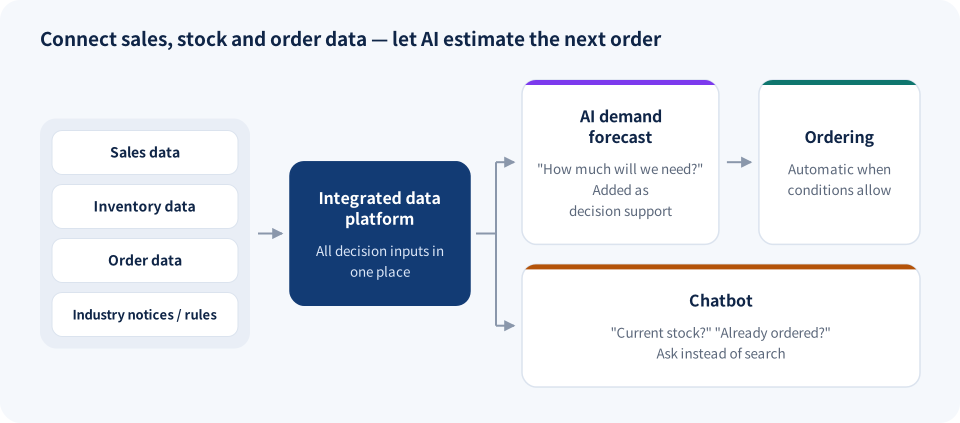
Sales, inventory, orders, industry notices and regulatory information were brought into one system. Organising the information needed for a decision came before any AI: scattered data produces no usable answers, however good the model.
2. Let AI estimate what is needed next
AI demand forecasting on the accumulated sales and inventory data gives staff a "how much will we need" input they used to assemble by hand. Where conditions allow, the system proceeds to ordering automatically, keeping the sales → stock check → forecast → order flow unbroken.
3. Ask for information instead of searching for it
A chatbot answers questions such as "recent sales of this item?", "current stock?", "quantity already ordered?", cutting the time spent hunting through admin screens.
What we learned
AI, forecasting and auto-ordering sound advanced, but the starting questions were simple: why do we run out, why is stock left over, and where does staff time go every day? Connect the data, make information easy to find, use forecasts as decision support, automate the repetitive parts. AI is one tool inside that flow.