Introduction
A prolonged period of yen volatility has made life harder for Japanese IT companies, including on the cost of outsourced software development. At the same time, Generative AI tools such as GitHub Copilot and Cursor let a single engineer write code far faster than before. Against that backdrop, many companies have decided to bring part of their development back in-house. It is an understandable, reasonable strategic move.
Using AI to cut costs and take direct control of projects reflects real effort to innovate. Yet in conversations with partners in Tokyo and Osaka, we keep seeing the same blind spot (盲点) appear once this model runs in practice: project managers are overloaded, and the system architecture carries hidden risk.
This article is not an argument against going in-house. We want to share what we have observed, and a way of dividing roles that companies may want to consider.
1. Three common challenges of in-house development with AI
AI speeds up writing code, but it does not take over project management or quality control. In many teams, that work lands on a small group of the most experienced people.
Challenge 1: PMs and tech leads become "AI reviewers"
AI can produce thousands of lines of code in minutes. Knowing whether that code matches the business rules, is secure and fits the existing system still takes the most experienced engineers reading it line by line. So PMs and tech leads who should be spending their time on the market, on business logic and on product direction end up spending most of their day writing prompts, reviewing code and fixing bugs.
Their core strengths get tied up in micro-tasks.
Challenge 2: Legacy systems and security
AI does well on isolated problems with a clear scope. When its output has to fit into a system that has run for years, with data constraints, unwritten business rules and strict security standards, it often lacks the big picture.
Without an independent QA team and a disciplined test process, small deviations are hard to catch before production. When an incident happens, the company carries all of the risk, including the cost of the fix and the impact on its own customers.
Challenge 3: The opportunity cost of senior time
Spending on third parties may go down, but opportunity cost goes up. Senior managers' time in Japan is expensive. Using it for purely technical work, such as reviewing every pull request or running regression tests, is not necessarily the most cost-effective choice over the long run.
A full cost comparison should include this time, not only how much the outsourcing invoice went down.

2. Outsourcing is changing too: from "build to spec" to co-management
Outsourcing companies in Vietnam, ARIS Vietnam included, are redefining their role in response to these pressures. Japanese clients no longer need a team that "takes a spec and types code". They need a team that can take on the technical operations AI cannot yet handle.
That is why we propose a hybrid, AI-augmented offshore model, with roles divided as follows.
The Japanese company keeps the core. You focus on product direction, business requirements and market strategy, and keep decision rights at key milestones.
ARIS Vietnam takes on technical operations. Our bridge system engineers (BrSE) and PMs act as co-PMs. We take in requirements, clarify the spec, use AI under agreed controls to speed up development, and take responsibility for code review, testing and output quality before delivery.
The scope of AI use is agreed with the client for each project, and every change to the main branch is reviewed and approved by an engineer. This is also the principle behind the Hybrid Delivery Model that ARIS Vietnam announced.
3. The two models side by side
| In-house with AI | Hybrid with ARIS Vietnam | |
|---|---|---|
| Who writes prompts and reviews AI code | PM / tech lead in Japan | ARIS BrSEs and engineers |
| Who tests and assures quality | The internal team | ARIS QA team, reporting results to the client |
| Where the Japanese PM's time goes | Mostly technical work | Business logic and product |
| Risk when something breaks | Carried entirely by the company | Shared according to the agreed scope of responsibility |
| What you receive | Code that still needs checking | A tested product, with a test report |
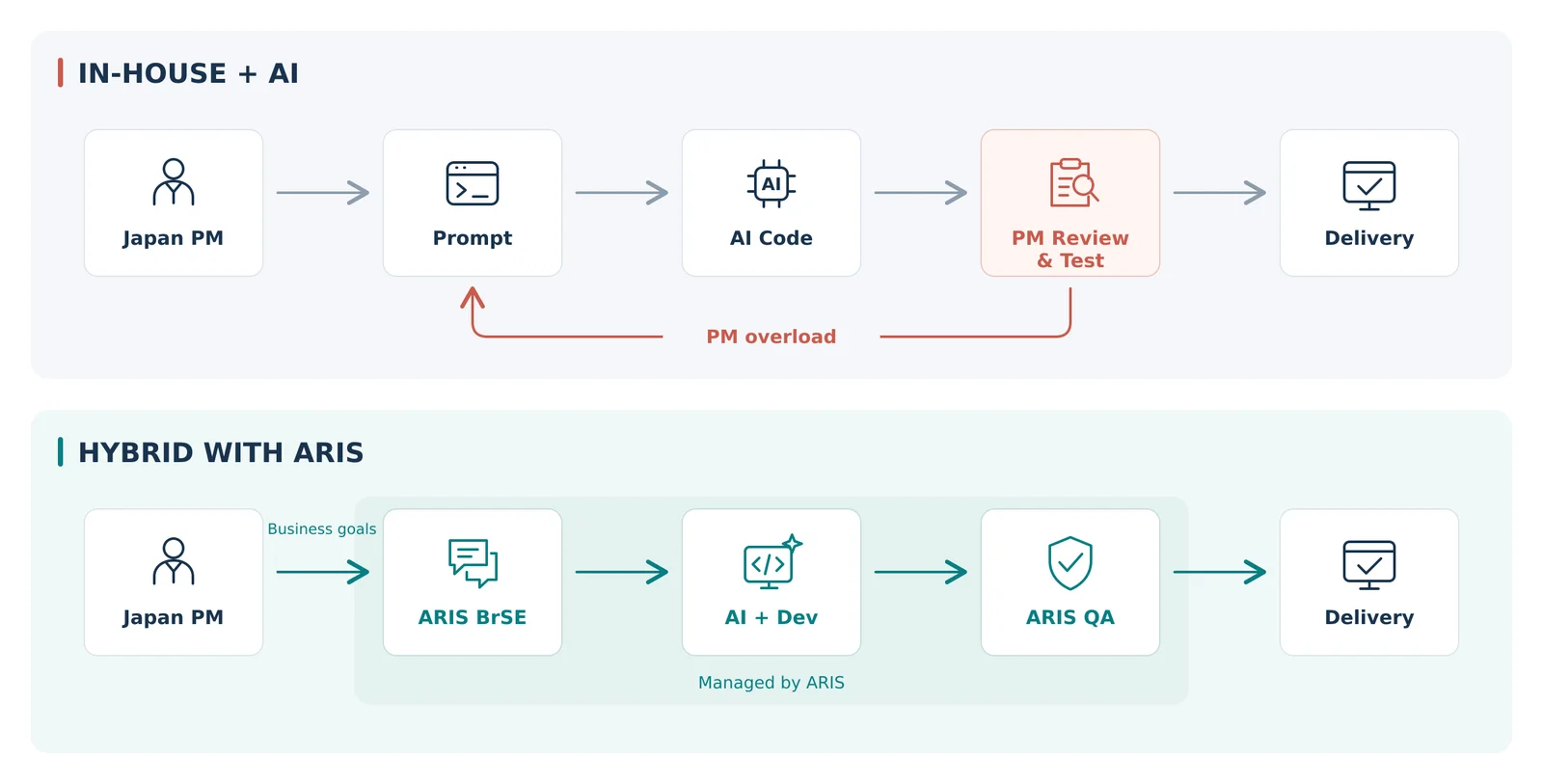
In the in-house model, review and testing loop back to the Japanese PM; in the hybrid model, ARIS covers everything from BrSE to QA.
Put simply: in the in-house model, the loop of "write a prompt, AI generates code, PM reviews and tests it" always comes back to the PM. In the hybrid model, the Japanese PM hands business logic to a BrSE, the Vietnam team builds with AI, ARIS tests it, and you receive a finished product.
The BrSE role itself has changed a lot in the AI era. We go into more detail in BrSE in the AI Era: From Translating Specs to Architecture.
Closing: building lasting value together
AI exists to free people up, not to keep a company's best minds busy fixing bugs. Combining AI, the business vision of Japanese companies and the flexible technical operations of a Vietnamese team is a direction worth considering for the cost and quality questions of a weak-yen period.
At ARIS Vietnam, we are always ready to hear about the practical challenges you face and design a way of working together that is flexible, secure and fits your situation. You can read more about our PM/BrSE setup and engagement options on our offshore software development in Vietnam page.
