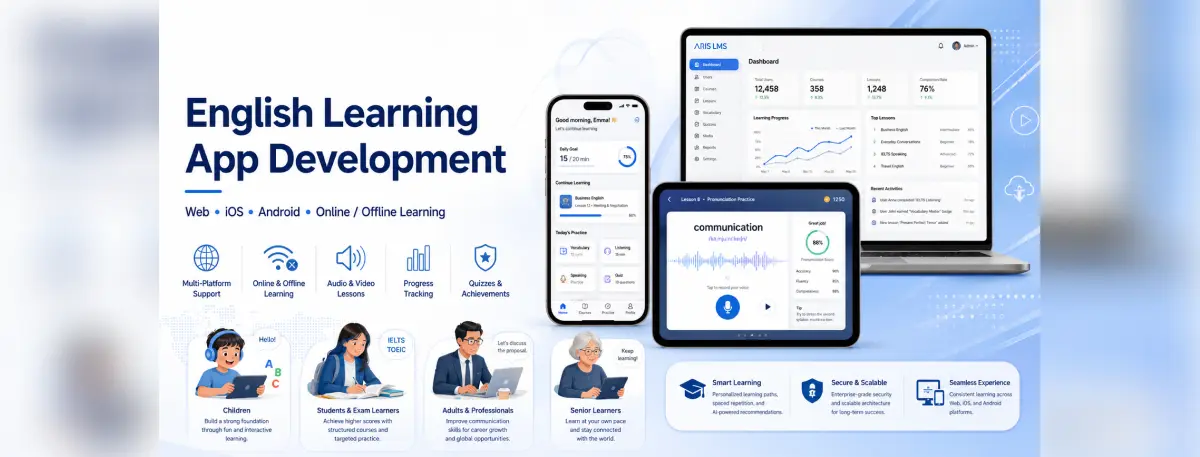
English learning methods have changed significantly in recent years. In addition to traditional textbooks and classroom learning, users now expect diverse learning experiences through smartphone apps, web apps, video lessons, audio content, gamified learning, and personalized study flows.
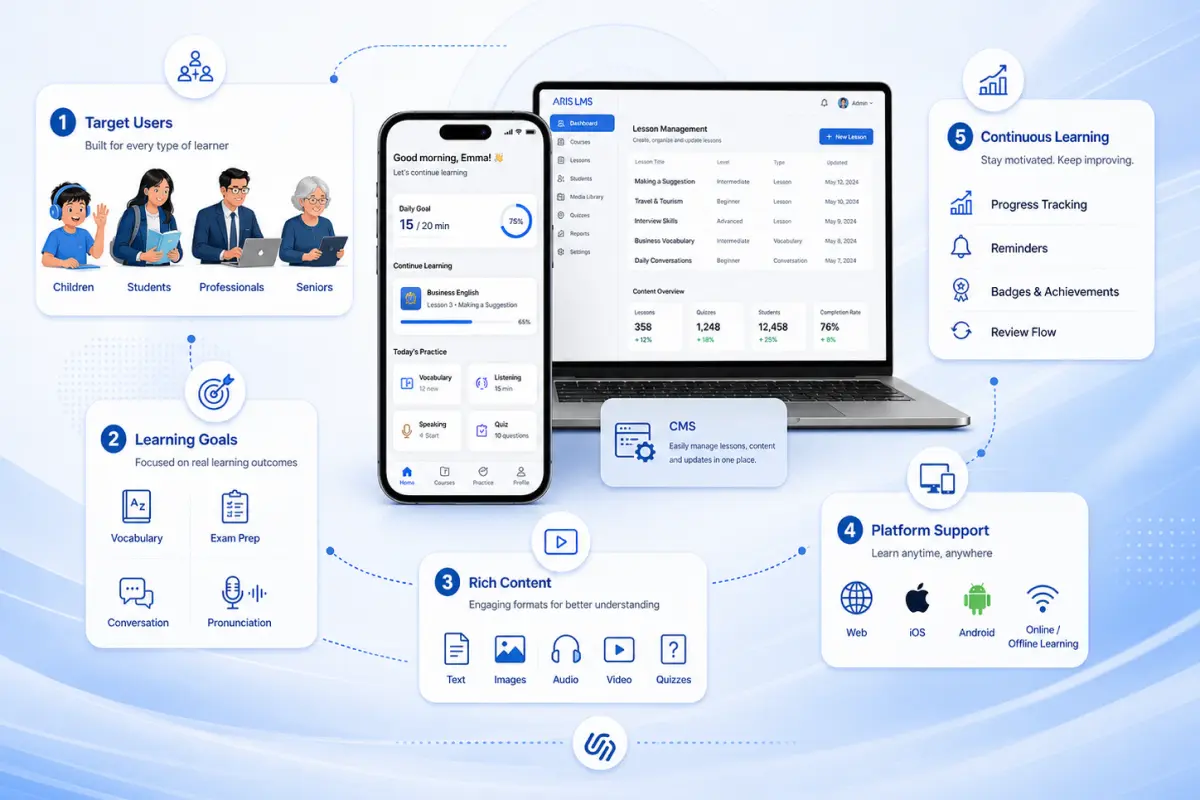
An English learning app can serve many different user segments: children who need a fun and visual experience, students preparing for exams, business professionals who want practical English, users who want to improve vocabulary or conversation skills, and senior learners who need a simple and easy-to-use interface. Each target group requires different functions, content design, and UI/UX.
ARIS Vietnam has supported the development of various English learning apps, learning support systems, and web/mobile applications for different age groups and learning purposes. This article introduces key points in English learning app development and ARIS Vietnam's development support.
The role of English learning apps
The role of an English learning app is not simply to digitize learning materials. A successful learning app needs to help users continue learning through well-designed content, intuitive operation, progress tracking, review flows, and motivation mechanisms.
English learning covers many goals, including listening, speaking, reading, writing, vocabulary, grammar, pronunciation, conversation expressions, and exam preparation. Therefore, the target users and learning goals should be clearly defined before deciding the system structure and feature set.
Designing learning experiences by age group
The learning experience changes greatly depending on the target age group.
Apps for children
For children, fun, intuitive operation, visual clarity, and interactive content are essential. Instead of text-only materials, the app should combine illustrations, characters, audio, animation, quizzes, and gamified elements so that children can naturally engage with English.
Examples include flashcards, listening quizzes, chants, rhythm-based activities, conversations with characters, achievement badges, and reward mechanisms that encourage continuous learning.
Apps for students and exam learners
For students and exam learners, learning scope, target score, progress tracking, review functions, and weakness analysis are important. Vocabulary, grammar, listening, reading comprehension, mock tests, and review functions can be combined to support efficient exam preparation.
Based on learning history and correct answer rates, the system can visualize weak areas and automatically suggest review questions.
Apps for adults and business professionals
For business professionals, practical expressions, short lessons, and a UI that supports continuous learning are important. Content can be designed around real work scenarios such as business emails, meetings, presentations, phone calls, negotiations, and overseas business trips.
Short lessons that can be completed during commuting or break time, combined with audio playback, shadowing, conversation practice, and review reminders, are effective for busy learners.
Apps for senior learners
For senior users, visibility, simple navigation, larger text, easy audio playback, and a calm learning flow are important. Instead of adding too many functions, the app should focus on ease of use and a sense of achievement.
Content such as travel English, daily conversation, and English as a hobby can be designed in a friendly and accessible way.
Feature design based on learning purpose
English learning apps require different features depending on the learning goal.
Exam preparation apps
For TOEIC, EIKEN, IELTS, TOEFL, and other exam preparation apps, key features include practice questions, mock tests, score tracking, weakness analysis, and review functions. Visualizing correct/incorrect history, category accuracy, study time, and progress toward target scores helps users learn efficiently.
Vocabulary learning apps
Vocabulary learning requires repetition and memory retention design. Flashcards, example sentences, audio, pronunciation, images, quizzes, automatic review of missed words, and adaptive question frequency can support continuous vocabulary improvement.
Conversation and pronunciation practice apps
For conversation and pronunciation practice, useful functions include audio playback, recording, pronunciation comparison, phrase practice, role-play, AI chat, and speech recognition integration. Designing a flow that encourages users to speak out loud helps move learning from passive input to active output.
Gamified learning apps for children
For children, quizzes, rhythm games, card games, character growth, stage completion, points, badges, and rewards can support motivation. However, the balance between fun and learning effect is important. The app should not become only a game without clear learning value.
Importance of content design
In English learning apps, content design is just as important as system features. ARIS Vietnam has supported learning apps that combine text, images, audio, videos, illustrations, and animations.
Images and illustrations make words and expressions easier to understand, especially for children and beginners. Audio content is essential for listening, pronunciation, shadowing, and conversation practice. Video content is effective for teaching mouth movement, conversation scenes, lectures, and explanations.
Because learning apps require ongoing content updates after release, the content structure should be easy to manage. Lessons, questions, audio, videos, images, categories, levels, and tags should be designed for future updates. A web admin panel or CMS can help the operation team add and edit content without changing the app each time.
Development for Web, iOS, and Android
English learning services often combine web, iOS, and Android depending on the use case. Web apps are suitable for admin panels, learning management, corporate management, and teacher/admin functions. Smartphone apps are suitable for daily learning, push notifications, audio playback, offline learning, and short study sessions.
ARIS Vietnam can support both native app development and hybrid app development depending on service requirements, budget, and future expansion plans. Native development is suitable when performance, device functions, audio/video handling, and platform-specific optimization are important. Flutter and React Native can be effective when a service needs to support both iOS and Android efficiently.
Online and offline learning support
English learning apps may need to support both online and offline learning. Users may want to study while commuting, traveling, at school, in facilities, or in environments with unstable internet connection. In such cases, lessons, audio, videos, and part of the learning history may need to be stored on the device.
Offline support requires careful design for data synchronization, content updates, learning history reflection, license management, and storage control. For apps with many audio and video files, balancing communication volume and device storage is especially important.
Functions that support continuous learning
The most important factor for an English learning app is whether users continue learning. Useful functions include progress tracking, study calendar, goal setting, review reminders, notifications, accuracy and weakness analysis, level-based content, badges, points, rankings, favorites, review lists, and visualization of learning history.
However, not all features need to be implemented from the beginning. The MVP scope should be defined according to target users and learning goals, then improved gradually based on real usage data.
Points to consider when developing English learning apps
-
Define the target users clearly — Children, students, business professionals, and senior learners require different UI, font size, navigation, content, and notification frequency. Clarifying who the app is for is the first step toward successful development.
-
Clarify the learning goal — Exam preparation, vocabulary learning, conversation practice, pronunciation training, and business English all require different content and features. If the learning purpose is unclear, the app value becomes difficult to understand.
-
Plan content management from the beginning — Learning materials and questions will continue to be updated after release. Therefore, it is better to manage content through an admin panel or CMS instead of embedding all materials directly in the app.
-
Pay attention to audio and video quality and file size — Audio and video improve learning effectiveness, but they also require careful consideration of file size, network speed, playback quality, copyright, and storage.
-
Design for long-term use — Learning apps are not used only once. To keep users engaged, the service should continuously improve learning history, notifications, review flows, achievement mechanisms, and UI.
ARIS Vietnam's experience in English learning app development
ARIS Vietnam has supported the development of various English learning apps and learning systems for children, students, adults, business professionals, and senior learners. Learning purposes include exam preparation, vocabulary building, conversation practice, listening, and pronunciation training.
ARIS has also supported rich content apps using images, audio, video, and animation, as well as apps that support both online and offline learning. We have experience with multi-platform development covering web, iOS, and Android.
Due to confidentiality, specific app names and detailed specifications may not be disclosed, but ARIS has experience in the following areas:
- English learning apps for children
- English learning apps for adults and business users
- Learning support apps for senior users
- Exam preparation apps
- Vocabulary learning apps
- Conversation and listening practice apps
- Apps using audio and video content
- Offline learning apps
- Learning systems with web admin panels and CMS
- Native iOS / Android apps
- Hybrid apps using Flutter / React Native
ARIS Vietnam's mobile app and learning system development support
ARIS Vietnam supports not only English learning apps but also educational apps, business apps, matching apps, reservation apps, and membership apps.
We can support the full process from initial consultation, requirement definition, UI/UX design, web system development, iOS/Android app development, API development, admin panel, QA/testing, release, and maintenance.
Main areas ARIS can support
- Planning and requirement definition for English learning apps
- Learning flow and content structure design
- UI/UX design
- iOS / Android app development
- Hybrid app development with Flutter / React Native
- Web app, admin panel, and CMS development
- Audio and video content integration
- Online and offline learning support
- Learning history and progress management
- Notifications and reminders
- Subscription, billing, and user management
- QA, testing, release support
- Maintenance and continuous improvement
Flexible development aligned with the business model
The required features of an English learning app depend on target users, revenue model, content volume, and operation structure. ARIS Vietnam supports MVP development, full-scale development, improvement of existing apps, multi-platform expansion, and long-term maintenance based on each customer's business model and service strategy.
We also design systems with future maintenance in mind, making it easier to add content, expand functions, improve UI, respond to OS updates, and optimize performance.
Conclusion
English learning apps require different design approaches depending on target age, learning purpose, content format, and usage environment. Children need fun and intuitive experiences, business users need short and practical learning flows, exam learners need progress tracking and weakness analysis, and conversation learners need audio and output-oriented practice.
Based on experience supporting various English learning apps and systems, ARIS Vietnam can provide end-to-end support from planning and requirement definition to web/mobile app development, content management, QA, release, and maintenance.
If your company is considering a new English learning app, improving an existing app, supporting web and mobile platforms, online/offline learning, or multi-platform expansion, please feel free to contact ARIS Vietnam.
