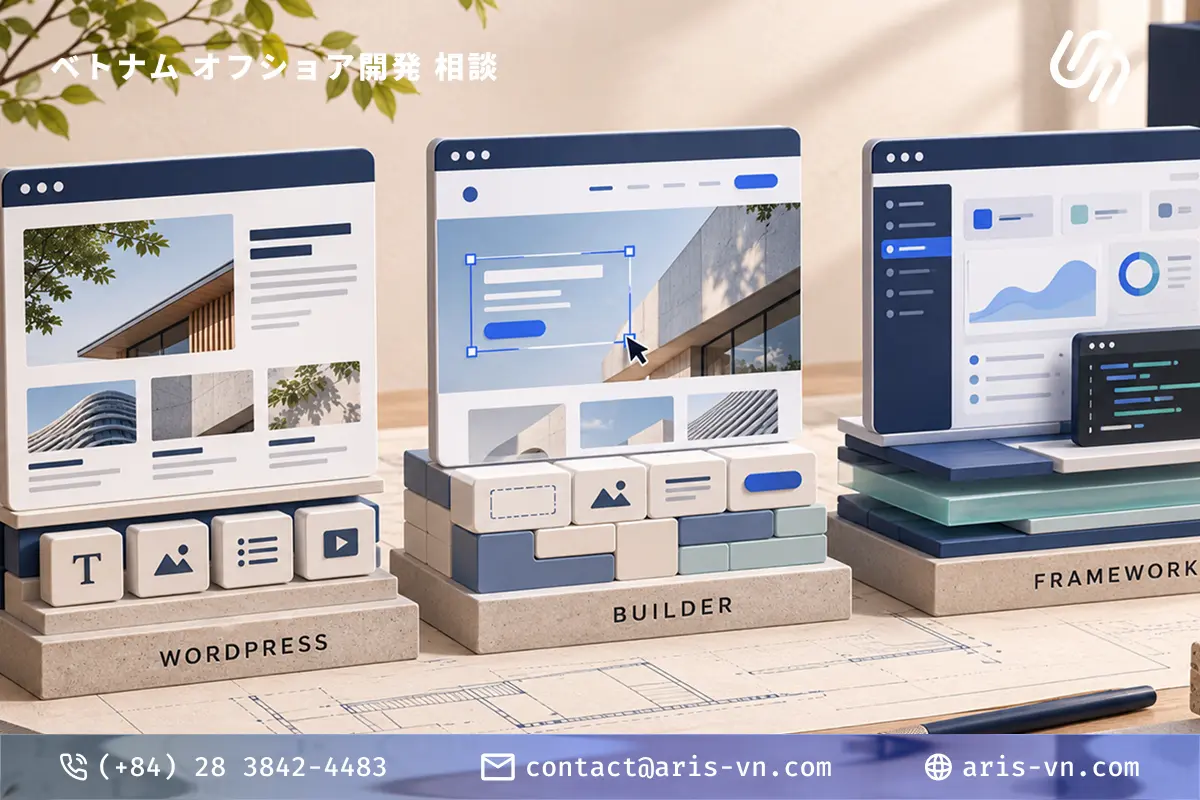
Choosing the tech to build a website on isn't like picking a theme — it's a multi-year commitment. Switching foundations midway means near-rebuilding from scratch, and usually drags down SEO as URL structures change. So the question isn't "which is the fanciest", but "which can I live with for the next 3 years".
There's no "best", only "best-fit"
The common mistake is choosing the tech first and cramming requirements in later. Do the reverse: ask what the site is for, who maintains it, how far it needs to scale — then map that to a tool.
The three main options (2026)
 WordPress / CMS
- Clients can manage content themselves with no dev; fast and cheap to launch
- Talent is everywhere, easy to hand over
- Heavy; speed depends on hosting + plugins
- A top hacker target — 11,334 WordPress vulnerabilities in 2025 (+42%) (Patchstack). The recent PHP2Shell vulnerability is a case in point.
- Plateauing: ~40% of all websites (W3Techs, Oct 2026), down from a 43.6% peak
→ Good for: brochure sites, blog/SEO content, small–mid shops.
 Website builder (Webflow / Framer / Wix)
- Fast, polished, drag-and-drop, almost no code
- Limited customization
- Platform lock-in (hard to move your site) + a monthly fee forever
→ Good for: landing pages, portfolios, marketing sites you need live in days.
 Modern framework (Next.js)
- Superior speed and technical SEO; near-unlimited customization
- Better security; room to grow into a product
- In 2026, Next.js is the most widely used React meta-framework, with strong hiring demand (Astro is worth a look for content-heavy sites)
- Needs a developer; clients can't easily self-edit without a CMS
→ Good for: high performance/SEO, bespoke logic, brand differentiation, or a product roadmap.
(Building a website in pure from-scratch code with no framework? Basically irrational now — the framework is how you write "custom" today.)
| You need | Platform |
|---|---|
| Brochure site, blog, self-managed content | WordPress |
| Landing/portfolio live in days | Website builder |
| Speed, technical SEO, brand differentiation | Framework (Next.js) |
| Bespoke logic, systems, product roadmap | Framework (Next.js) |
What changed: AI-assisted development
This is where the calculus differs from 3 years ago. Frameworks used to be expensive and slow, so many defaulted to WordPress. Now vibe coding (AI-assisted development) went mainstream in 2026 — around 41% of businesses use AI to build websites — making a custom Next.js site far faster and cheaper to stand up. The balance tips toward frameworks for many projects that weren't "worth it" before.
But don't misread it: AI makes building faster, it doesn't replace understanding architecture and security. GitGuardian's 2026 report logged 28.65 million secrets (passwords/API keys) hardcoded into public GitHub in 2025, up 34% — largely from building fast without control. You still need a human at the wheel.
Not sure what to pick? Try the quick quiz
Answer 3 questions for a platform recommendation tailored to your project — and if you like, leave your details for specific advice from ARIS.
Which platform should your website be built on?
Answer 3 questions to get a recommended platform.
1. What is this website mainly for?
2. Who will update the content regularly?
3. What is your top priority?
Common misconceptions
Does using a framework (Next.js) mean hand-coding everything, with no admin like WordPress?
No. Pair it with a headless CMS (Strapi, Sanity, Payload…) and clients publish and edit content as easily as in WordPress — the only difference is a custom-built interface instead of a ready-made theme.
WordPress is free, so isn't it always cheaper?
The license is free, but the 3-year total cost also includes hosting, paid plugins, maintenance and security patching. Over the full lifecycle, many framework projects work out cheaper.
If AI writes the code, do we still need a developer?
AI makes building faster; it doesn't replace understanding architecture and security. Building carelessly with AI is exactly why 28.65 million secrets leaked on GitHub in 2025 — you still need a human at the wheel.
Can't we just pick anything and switch platforms later?
Switching platforms is close to a full rebuild, with a real risk of SEO ranking loss from changing URL structures. That's why it pays to choose by your needs and a 3-year view from the start.
WordPress is used everywhere, so isn't it safer?
It's the opposite: the more popular a platform, the larger its attack surface. 2025 logged 11,334 WordPress vulnerabilities — safety depends on how you operate and update, not on user numbers.
Bottom line
Choose your foundation by the problem + a 3-year view, not by trend. The good news: with AI-assisted dev, "doing it properly with a framework" is now within reach for far more projects than before.
Sources: W3Techs (Oct 2026), Patchstack, State of JS 2025, GitGuardian (2026).
