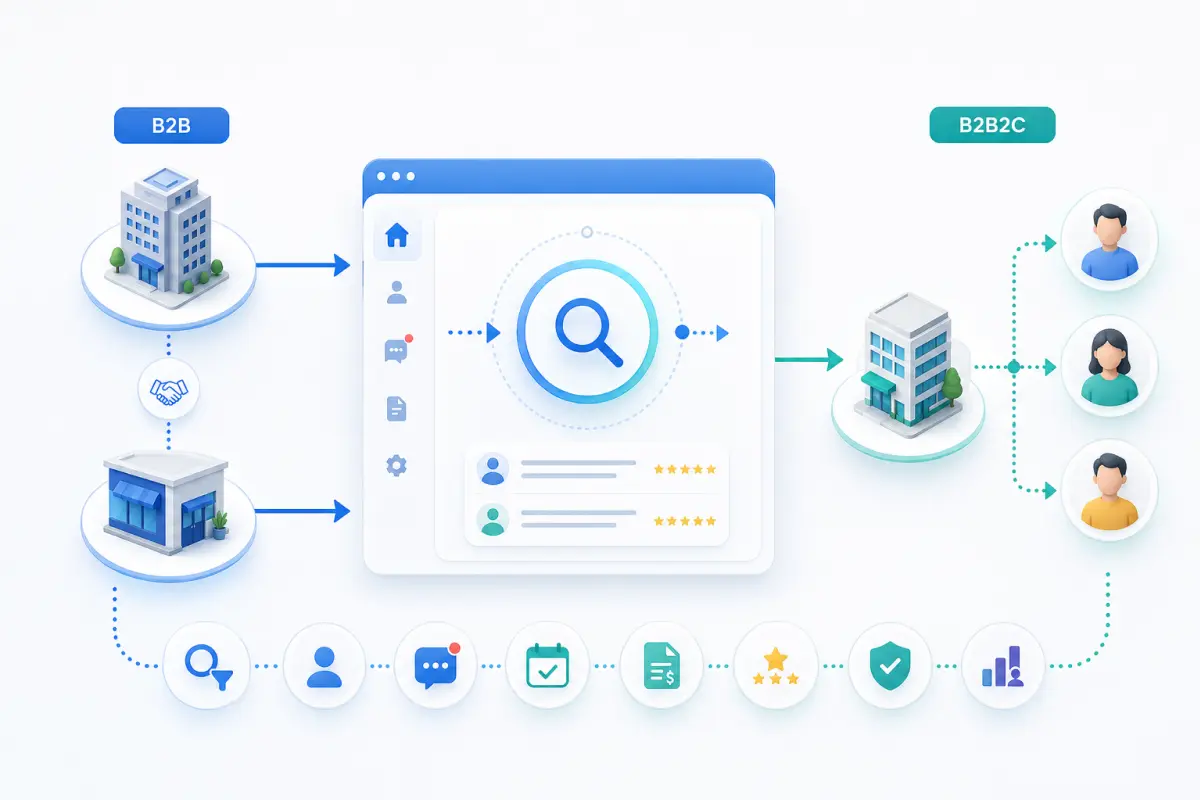
In recent years, matching services that connect companies with companies, companies with individuals, and service providers with end users have become increasingly common across many industries.
Tasks that were traditionally handled by phone, email, spreadsheets, or manual introductions can now be managed through web systems and mobile apps. A matching platform can centralize project information, user profiles, search conditions, applications, requests, contracts, progress tracking, notifications, and reviews.
For B2B and B2B2C matching services, the system is not just about connecting users. It must also support business-specific operations such as company account management, approval workflows, project management, pricing models, identity verification, quality control, and platform administration.
This article explains the characteristics of B2B and B2B2C matching services, the industries where this model is widely used, key points to consider when building web systems and apps, and how ARIS Vietnam can support matching service development.
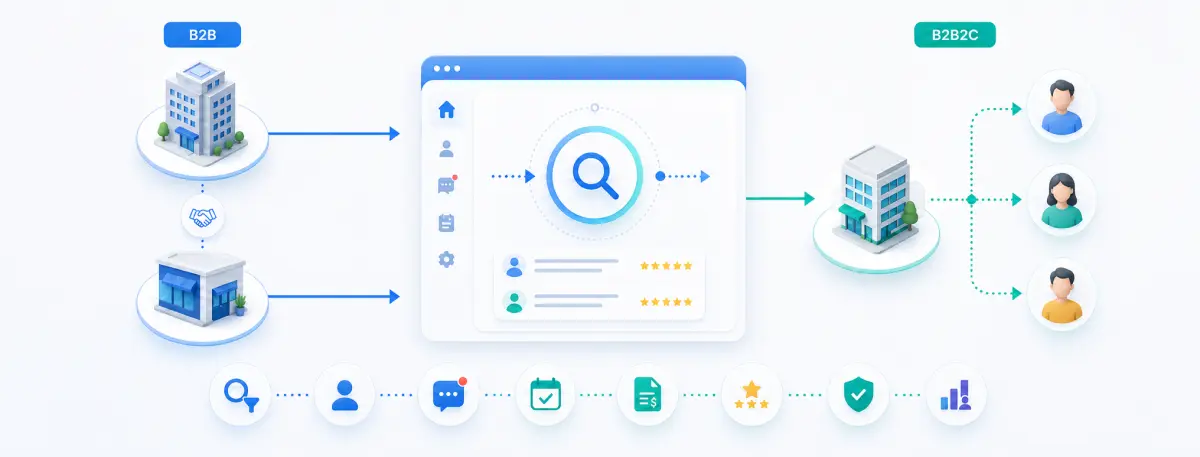
What Is a Matching Service?
A matching service is a platform that connects companies or individuals who provide services with companies or individuals who need those services. Typical examples include recruitment, job matching, freelance work, interpretation and translation, logistics, expert consultation, education, healthcare, nursing care, real estate, construction, and facility services.
The value of a matching service is not simply to list information. Its real value lies in helping users efficiently find the right counterpart, make inquiries, request quotes, place orders, sign contracts, receive services, and evaluate results through a smooth process.
Characteristics of B2B Matching Services
B2B matching services usually connect companies with other companies, or companies with professional service providers. Common examples include IT vendor matching, freelance or specialist talent matching, interpretation and translation provider matching, logistics matching, consultant or professional service matching, and supplier matching.
In B2B, transactions are often larger and decision-making usually involves multiple stakeholders. Therefore, simple search and application functions are not enough. The platform needs to support company accounts, departments, multiple users, role-based permissions, quote requests, approval workflows, contract management, billing, and reporting.
Characteristics of B2B2C Matching Services
In the B2B2C model, the platform operator brings together business partners and delivers services to end users through those partners. Examples include medical appointment platforms, education marketplaces, nursing care or life-support services, real estate portals, expert consultation platforms, and reservation/order services.
B2B2C services must balance two sides: operational efficiency for business partners and usability for end users. Business users need admin screens, reservation management, customer management, reporting, billing, notifications, and status tracking. End users need simple search, clear profiles, easy booking or application flows, messaging, notifications, and reviews.
Industries Where Matching Services Are Commonly Used
Recruitment, HR, and Freelance Work
Recruitment companies, employers, job seekers, freelancers, and professional talent networks are among the most common areas for matching services. Matching logic often needs to consider job category, skills, experience, location, work style, rate, availability, and timing.
Interpretation, Translation, and Professional Services
Platforms that connect interpreters, translators, agencies, and clients are highly compatible with a matching model. Search criteria may include language, industry expertise, availability, location, remote support, pricing, track record, and reviews.
Logistics, Delivery, and Field Services
Matching shippers with logistics providers, companies with field workers, or businesses with maintenance service providers requires real-time features such as area coverage, vehicle type, working hours, service type, urgency, status tracking, and field reporting.
Healthcare, Nursing Care, and Wellness
B2B2C matching can also be used to connect clinics, care providers, specialists, patients, users, and families. In these areas, privacy protection, access control, appointment management, records, notifications, and audit logs are especially important.
Education, Training, and Skill Sharing
Platforms that connect teachers, schools, training companies, students, and corporate learners can combine course search, instructor profiles, booking, learning history, payment, reviews, and ongoing learning management.
Real Estate, Construction, and Housing Services
Matching can also support property search, construction or repair requests, contractor matching, quotation requests, inquiries, and progress management. In information-rich domains, search usability and admin operations are key success factors.
Key Functions for Matching Service Development
User and Company Account Management
B2B and B2B2C platforms need to manage not only individual users but also company accounts, departments, staff members, permissions, and approvers. In B2B, multiple users may belong to the same company, and each user may have different access rights.
Profile and Service Information Management
Service providers need to register company information, user profiles, skills, service categories, experience, pricing, service area, availability, qualifications, and reviews. These details become key information for comparison and decision-making.
Search, Recommendation, and Matching Logic
Search and matching logic is the core of the service. Category search, keyword search, location search, skill filters, availability filters, and price filters help users find the right counterpart. As the service grows, recommendation logic using browsing history, application history, reviews, conversion rate, and response speed can also be considered.
Inquiry, Application, and Request Flows
The platform must define how users move from matching to inquiry, application, quote request, booking, confirmation, contract, service delivery, completion report, and review. An unclear workflow increases manual operations and causes misunderstandings between users.
Messaging and Notifications
Matching services often require communication between users and sometimes with the platform operator. Chat, messages, email notifications, push notifications, and reminders help reduce missed responses and user drop-off.
Admin Panel and Operations Support
The admin panel is a critical component. It should support user management, company management, project management, inquiry management, screening, reporting, status management, fee management, revenue tracking, and data export.
Reviews, Ratings, and Quality Control
Reviews, ratings, service history, cancellation history, and operator screening help maintain service quality. In professional services and HR matching, trust directly affects conversion rates.
Payment, Billing, and Fee Management
Depending on the business model, the platform may need to support payment, invoicing, transaction fees, subscriptions, success fees, monthly fees, or enterprise contracts. In B2B, invoice payment, monthly billing, company-specific conditions, and approval workflows are often required.
Important Points When Building a Matching Service
-
Clearly define who is being matched with whom — The first step is to clarify whether the service connects companies with companies, companies with individuals, or business partners with end users through a platform. This affects account structure, permissions, contracts, billing, workflows, and support operations.
-
Limit the MVP scope — Matching platforms tend to require many features, such as search, messaging, payment, reviews, notifications, recommendations, and admin tools. However, it is more realistic to start with the minimum functions needed to create matches, then add features gradually based on actual usage.
-
Do not overlook platform operations — The success of a matching service depends heavily on operations. Screening, inquiry handling, trouble support, status updates, content review, fraud monitoring, revenue tracking, and reporting should be supported through the admin panel.
-
Design flexible matching conditions — After launch, the platform may need to adjust matching criteria based on user behavior and conversion data. Data structures and search conditions should be designed with future expansion in mind.
-
Build trust and safety mechanisms — Because users interact directly with each other, the system should support identity verification, company verification, screening, reports, blocking, fraud detection, consent to terms, privacy protection, access control, and audit logs.
-
Clarify the roles of web and mobile apps — Web systems are suitable for admin panels, company operations, detailed data entry, and reporting. Mobile apps are effective for notifications, chat, booking confirmation, on-site actions, and simple status updates.
-
Build for maintainability and continuous improvement — Matching services continue to evolve after release. The architecture should support new plans, campaigns, search rule changes, notification rule changes, admin improvements, integrations, and performance improvements.
ARIS Vietnam Matching Service Development Experience
ARIS Vietnam has supported the development of multiple web systems and mobile apps for matching service businesses. Due to confidentiality, detailed service names and specifications cannot be disclosed, but our experience includes the following areas.
Case 1: Interpretation and Translation Matching System
ARIS supported the development of a matching system that connects companies or individuals providing interpretation and translation services with users who need those services. The system enables users to search providers based on language, specialty, availability, service area, pricing, and experience, then proceed to inquiries and requests.
Case 2: Recruitment Company and Job Seeker Matching System
ARIS supported a recruitment matching system connecting hiring companies and job seekers. The system included job information, company profiles, candidate profiles, applications, scouting, selection status, notifications, and admin management.
Case 3: B2B Matching System for Professional Service Providers and Corporate Projects
ARIS supported a B2B matching system connecting professional service providers with companies that need external resources. Companies register project requirements, skills, period, budget, and conditions, while providers register profiles, experience, service areas, and availability. In this model, operator-assisted recommendations can be combined with automated matching to improve conversion and quality.
ARIS Vietnam Development Support for Matching Services
ARIS Vietnam provides end-to-end development support for B2B and B2B2C matching services, including web systems, mobile apps, admin panels, backend APIs, QA, release support, and maintenance.
- Requirement definition and business flow design
- Web system and mobile app development
- Company and user account management
- Profile, project, and service information management
- Search, filters, and matching logic
- Inquiry, application, booking, and request workflows
- Chat and notification functions
- Admin panel and operation support functions
- Payment, invoicing, and fee management
- Reviews, ratings, and screening functions
- API and external service integration
- QA, testing, release support, and maintenance
ARIS designs systems based on the business model, including monthly fees, success fees, listing fees, transaction fees, subscriptions, and enterprise contracts.
Conclusion
B2B and B2B2C matching services are used in recruitment, interpretation and translation, professional services, logistics, healthcare, education, real estate, field services, and many other industries. To succeed, these platforms require not only search functions and app screens but also a well-designed business model, operations workflow, user management, screening, notifications, contracts, billing, admin tools, security, and maintainability.
ARIS Vietnam supports new matching service development, MVP development, app development, existing service improvement, and ongoing maintenance. If you are considering a B2B or B2B2C matching service, please feel free to contact us.
